
Myrmarachne formicaria
(De Geer, 1778)
Ant-mimicking jumping spider
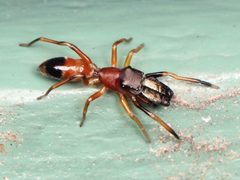
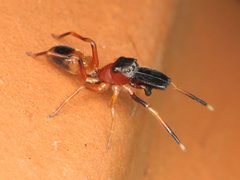
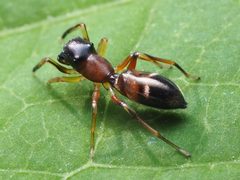
Myrmarachne formicaria is an -mimicking jumping spider (Salticidae) native to the Palearctic region and introduced to North America. It is one of few Myrmarachne found outside the tropics. The species exhibits sophisticated locomotor mimicry, with all eight legs while adopting ant-like postures and movement patterns. It was first recorded in the United States in Ohio in 2001 and has since spread to multiple states.
Pronunciation
How to pronounce Myrmarachne formicaria: /ˌmɜːrməˈrækni fɔːrmɪˈkɛəriə/
These audio files are automatically generated. While they are not always 100% accurate, they are a good starting point.
Identification
Distinguished from non-mimicking jumping spiders by -like and . Forelegs are raised like when stationary. Exhibits winding trajectories with characteristic short pauses (~100 ms). Unlike true ants, walks with all eight legs using a salticid alternating tetrapod gait rather than the six-legged gait of ants. present; males and females differ in morphology. Gynandromorphic individuals have been documented.
Images
Habitat
Specific natural requirements are not well documented. Collected in field conditions near human-modified environments in the Ithaca, New York area. Laboratory specimens maintained at 23±2°C in individual containers.
Distribution
Native to Palearctic region including Austria, Central Europe, Macaronesia, Turkey, Caucasus, Russia (European, Caucasus, and Far East regions), Iran, China, Korea, and Japan. Introduced to North America; first recorded in Trumbull County, Ohio, USA on 16 August 2001. Established now present in Pennsylvania, New York, and Canada.
Diet
In laboratory conditions, fed fruit flies (Drosophila melanogaster) and domestic crickets (Acheta domesticus). Natural diet in the wild is not documented.
Behavior
Exhibits quantitative locomotor mimicry of ants: walks with all eight legs using typical salticid alternating tetrapod gait, but raises forelegs like only when stationary. Produces winding trajectories with wavelength of 5–10 body lengths, resembling ants engaged in -trail following despite absence of chemical cues. Makes characteristically short pauses of approximately 100 ms, which create ant-like appearance to observers with slow visual systems. Males exhibit courtship toward females and agonistic behavior toward other males.
Ecological Role
Human Relevance
Non-native in North America with expanding range; first detected in 2001. Used as a model organism in studies of locomotor mimicry and protective mimicry systems.
Similar Taxa
- Myrmarachne spp.Other ant-mimicking jumping spiders in the same ; M. formicaria distinguished by its temperate distribution and specific locomotor patterns including foreleg-raising only when stationary and characteristic winding trajectories
- True ants (Formicidae)Mimicry target; distinguished by six-legged locomotion, elbowed , and constriction between and that M. formicaria only approximates through posture and movement
Sources and further reading
- BugGuide
- Wikipedia
- GBIF taxonomy match
- iNaturalist taxon
- NCBI Taxonomy
- Catalogue of Life
- Inferring the invasive stage of Eurasian spider Myrmarachne formicaria in North America using species distribution models
- Morphology and sex-specific behavior of a gynandromorphic Myrmarachne formicaria (Araneae: Salticidae) spider
- Walking like an ant: a quantitative and experimental approach to understanding locomotor mimicry in the jumping spider Myrmarachne formicaria