
Hentzia chekika
Richman, 1989
Hentzia chekika is a of jumping spider in the Salticidae, first described by David B. Richman in 1989. It belongs to a characterized by sexually dimorphic males with enlarged, often darkened front legs used in . The species occurs in the southeastern United States, Bahamas, and Cuba.
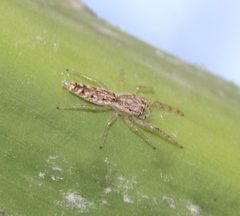
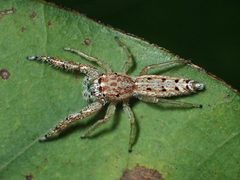
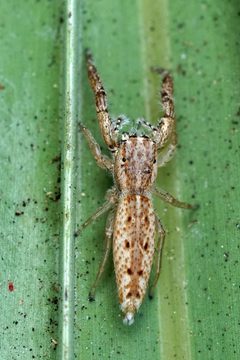
Pronunciation
How to pronounce Hentzia chekika: /ˈhɛntsiə tʃɛˈkiːkə/
These audio files are automatically generated. While they are not always 100% accurate, they are a good starting point.
Identification
Members of the Hentzia can be distinguished from other salticid genera by the pronounced in leg : males possess enlarged, conspicuously colored front legs that serve as visual signals during courtship and agonistic encounters. Specific identification of H. chekika requires examination of genitalic characters and comparison with H. palmarum and H. mitrata, which share overlapping ranges in the southeastern United States. The was established based on specimens from Florida and differs from H. palmarum in details of male palpal and female epigynal structure.
Images
Distribution
Southeastern United States (Florida and adjacent states), Bahama Islands, and Cuba. The occupies Caribbean and North American faunal regions.
Similar Taxa
- Hentzia palmarumOccurs sympatrically in the southeastern United States; males similarly possess enlarged dark front legs, but differs in genitalic and was described by W. H. Peckham & G. W. Peckham in 1888, predating H. chekika.
- Hentzia mitrataAnother eastern North American with similar male leg modifications; distinguished by specific palpal and epigynal characters, and occurs as far north as Canada.
More Details
Taxonomic History
Hentzia chekika was described by arachnologist David B. Richman in a 1989 revision of the Hentzia published in the Journal of Arachnology. The genus name honors the arachnologist W. H. Peckham's collaborator Hentz, though the etymology of the specific epithet 'chekika' was not explicitly stated in the original description.