
Habronattus ocala
Griswold, 1987
Ocala Paradise Spider, ocala jumper
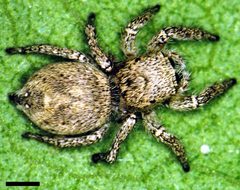
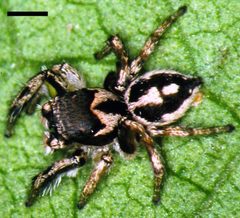
Habronattus ocala is a of jumping spider in the Salticidae, first described by Griswold in 1987. It belongs to the large Habronattus, which contains approximately 100 species primarily distributed in North America and the neotropics. The species is known from the United States, with the specific epithet suggesting a connection to the Ocala region of Florida. Like other Habronattus species, males likely exhibit elaborate involving visual and vibratory signals.
Pronunciation
How to pronounce Habronattus ocala: /hæbrəˈnætəs oʊˈkælə/
These audio files are automatically generated. While they are not always 100% accurate, they are a good starting point.
Images
Distribution
United States. The specific epithet 'ocala' suggests occurrence in or near the Ocala region of Florida, though precise distribution details are limited in available sources.
Behavior
As a member of the Habronattus, males likely engage in complex multimodal . Related Habronattus have been documented using both visual signals (leg movements, colored leg ) and acoustic signals (substrate-borne vibrations produced by drumming or tapping) during courtship. The third pair of legs in male Habronattus is often modified with spurs or bright coloration for visual display to females.
Similar Taxa
- Other Habronattus speciesApproximately 100 exist in this , many with similar body plans and male courtship . Identification to species level typically requires examination of genitalia under microscopy.
- Other Salticidae generaJumping spiders share characteristic large and compact body form, but Habronattus can be distinguished by the modified third legs in males used for .
More Details
Genus characteristics
Habronattus is one of the most diverse of jumping spiders in North America, with highest diversity in the southwestern United States and Florida. The genus is notable for having what may be the most elaborate courtship of any terrestrial , involving synchronized visual and vibratory signals.
Taxonomic note
Described by Griswold in 1987. The epithet 'ocala' likely refers to the Ocala region in Florida, suggesting this area as part of the type locality or known range.