
Habronattus jucundus
(G.W. Peckham & E.G. Peckham, 1909)
Habronattus jucundus is a of jumping spider in the Salticidae, occurring in the United States and Canada. Like other members of its , it is a small, ground-dwelling spider with acute vision adapted for active hunting. Males of Habronattus species are frequently noted for elaborate combining visual and vibratory signals. The species was described in 1909 by G.W. and E.G. Peckham, prominent early American arachnologists.
Pronunciation
How to pronounce Habronattus jucundus: //ˌhæbrəˈnætəs d͡ʒuːˈkʌndəs//
These audio files are automatically generated. While they are not always 100% accurate, they are a good starting point.
Identification
Identification to level requires examination of morphological details not provided in available sources. The Habronattus can be recognized by the combination of small size, ground-dwelling habits, and in males, often conspicuous leg modifications (particularly on the third pair of legs) used in . Distinguishing H. jucundus from would likely require examination of genitalic structures and detailed color pattern analysis.
Images
Appearance
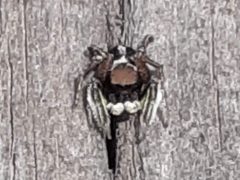
The is black in coloration. As a member of Habronattus, it is a small spider, typically measuring a few millimeters in body length. The is characterized by compact, stocky bodies with the enlarged typical of salticid spiders. is expected, with males potentially bearing modified leg structures or color patterns used in , though specific details for this species are not documented in available sources.
Habitat
Habronattus are typically found on the ground in areas of scattered vegetation, including prairies, grasslands, and open woodlands. They hunt on stones, amid leaf litter, and on low vegetation. The specific microhabitat preferences of H. jucundus have not been documented.
Distribution
Recorded from the United States and Canada. The shows highest diversity in the southwestern United States, with some ranging above the Arctic Circle and east to coastal Canada.
Behavior
As a member of Habronattus, this likely exhibits complex multimodal courtship . Males of related species perform elaborate displays combining visual signals (leg movements, color pattern presentation) with vibratory drumming or tapping on the substrate. These spiders are active hunters that rely on acute vision rather than web-building to capture prey. They are and nomadic, prowling across the ground and low vegetation in search of prey.
Ecological Role
As a small predatory spider, it contributes to in ground-level and low-vegetation . It serves as potential prey for larger arthropods, birds, and other vertebrates. The has been documented as a significant of bees and other flower-visiting insects in prairie .
Similar Taxa
- Other Habronattus speciesApproximately 100 exist in the , many with overlapping geographic ranges and similar general . Species-level identification requires detailed examination of genitalic structures and often male courtship characteristics.
- Other small ground-dwelling Salticidae (e.g., some Euophrys, Sassacus)Similar size, use, and general salticid body plan. Habronattus is distinguished by specific leg modifications in males and characteristic courtship .
More Details
Taxonomic note
The was described by George and Elizabeth Peckham in 1909. The Peckhams were pioneering American arachnologists who made substantial contributions to jumping spider and studies in the late 19th and early 20th centuries.
Research context
The Habronattus has been the subject of significant behavioral research due to the extraordinary complexity of male , which may represent the most elaborate terrestrial courtship known. However, most research has focused on a subset of well-studied ; H. jucundus has not been specifically documented in this literature.