
Habronattus americanus
(Keyserling, 1885)
Habronattus americanus is a of jumping spider in the Salticidae, native to western North America. Males are distinguished by black coloration with bright red and leg markings used in to attract females. The species is part of the diverse Habronattus , known for elaborate multimodal courtship involving visual, vibratory, and acoustic signals. Research indicates strong female preference for male red ornamentation, which can drive interspecific mating dynamics with related species.


Pronunciation
How to pronounce Habronattus americanus: /hæbrəˈnætəs əˌmɛrɪˈkeɪnəs/
These audio files are automatically generated. While they are not always 100% accurate, they are a good starting point.
Identification
Males are readily identified by the combination of black body with bright red and red leg markings. Females are more cryptic, brown and gray, and may require examination of genitalia for definitive identification. Distinguished from similar Habronattus by specific male color pattern and genitalic ; microscopic examination of pedipalps and may be necessary for confirmation.
Images
Habitat
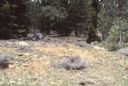
Found on conifer litter in exposed areas, often near sagebrush (Artemisia). Occupies ground-level with scattered vegetation, including stones and leaf litter. Alpine and montane occur on Mount Shasta, California.
Distribution
Western North America from British Columbia, Canada south to California, USA. Ranges eastward into Alberta and Montana. Specific documented from South Lake Tahoe, California and Mount Shasta, California.
Diet
Active of small arthropods. Males have been observed to travel extensively while forgoing feeding during mate search; females spend approximately 10% of time hunting and feeding.
Behavior
Males invest heavily in locomotory mate search, traveling more than females. Courtship involves elaborate multimodal displays: visual signaling with raised legs, vibratory signals (percussive and tremulatory), and tactile components. Males perform short multimodal displays characterized by zigzag approach and foreleg movement. Male-male interactions are brief and lack direct antagonism; competition occurs primarily through for dispersed females. Females frequently reject courting males, indicating strong mate choice.
Ecological Role
in ground-dwelling . Part of the diverse jumping spider fauna that contributes to insect in western North American .
Similar Taxa
- Habronattus sansoniRecently diverged with brown-colored males performing long multimodal displays; females of both species show preference for H. americanus males with red ornamentation
- Habronattus kubaiHybridizes with H. americanus in montane contact zones on Mount Shasta, California; distinguished by white- and/or yellow-palped morphologies versus red-palped H. americanus
- Habronattus cuspidatusRelated with modified third legs bearing large spurs used in courtship; males lack the red characteristic of H. americanus
More Details
Sexual selection and coloration
Research demonstrates that female H. americanus possess strong latent preferences for red male ornamentation. Color manipulation experiments show that painting males of related red increases their mating success, supporting the hypothesis that red coloration drives female mate choice and can lead to unidirectional across species boundaries.
Hybridization dynamics
on Mount Shasta, California show extensive hybridization with H. kubai, with more hybrid than parental individuals in the contact zone. Despite distinct morphological phenotypes including red-, white-, and yellow-palped forms, genetic differentiation between parental and hybrid individuals is minimal, indicating recent divergence and ongoing .
Sources and further reading
- BugGuide
- Wikipedia
- GBIF taxonomy match
- iNaturalist taxon
- NCBI Taxonomy
- Catalogue of Life
- Congratulations, UC Davis Linnaean Games Team: National Champs! | Bug Squad
- Bug Eric: What a Spider!
- Bug Eric: September 2012
- Bug Eric: A Case of Predator Mimicry in the Bee Fly Genus Epacmus? (Diptera: Bombyliidae)
- Oklahoma is More than OK for Burying Beetles
- Bug Eric: A Couple of Weirdos
- Insights to the mating strategies of Habronattus americanus jumping spiders from natural behaviour and staged interactions in the wild
- Latent preference for red ornamentation drives interspecific mating in nascent jumping spider species ( Habronattus americanus group, F. Salticidae )
- High sexual display trait diversity without measured genetic divergence in a montane hybrid zone involving young species (Habronattus americanus subgroup, Araneae: Salticidae)