
Attulus ammophilus
(Thorell, 1875)
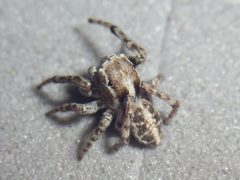
Attulus ammophilus is a jumping spider in the Salticidae, first described by Thorell in 1875. It is native to parts of Europe, Northern Asia, and Central Asia, with introduced established in North America. The species name 'ammophilus' suggests an association with sandy . Unlike the closely related and Critically Endangered Attulus distinguendus, this species has a broader distribution and is not considered threatened.
Pronunciation
How to pronounce Attulus ammophilus: //əˈtjuːləs əˈmoʊfɪləs//
These audio files are automatically generated. While they are not always 100% accurate, they are a good starting point.
Identification
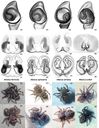
Attulus ammophilus can be distinguished from the similar Attulus distinguendus (Distinguished Jumping Spider) by distribution and context; A. distinguendus is restricted to two brownfield sites in the UK and is Critically Endangered, whereas A. ammophilus has a much wider Palearctic range. Specific morphological diagnostic features require examination.
Images
Habitat
The name 'ammophilus' (sand-loving) indicates association with sandy environments. Native occur in open, dry across its range. Introduced populations in North America have established in similar open, sandy, or sparsely vegetated conditions.
Distribution
Native to Romania, Ukraine, Russia (Europe), Turkey, the Caucasus, Iran, Kazakhstan, Central Asia, and Afghanistan. Introduced and established in Canada and the United States. Present across Europe and Northern Asia (excluding China).
Human Relevance
Attulus ammophilus is occasionally confused with the Critically Endangered Attulus distinguendus in conservation discussions, particularly regarding UK brownfield site protection. The two have been mentioned together in policy debates about development impacts on rare .
Similar Taxa
- Attulus distinguendusClosely related with similar appearance; distinguished by extremely restricted UK distribution (two brownfield sites only), Critically Endangered status, and smaller size (approximately 5mm). A. ammophilus has a broad Palearctic native range and introduced North American .
Misconceptions
The has been implicitly conflated with Attulus distinguendus in some public policy discussions, where 'jumping spiders' were broadly referenced without distinguishing between the critically endangered UK and the widespread A. ammophilus. The two species have distinct conservation statuses and geographic ranges.
More Details
Taxonomic note
Formerly placed in the Attus as Attus ammophilus Thorell, 1875; subsequently transferred to Attulus.
Etymology
The specific epithet 'ammophilus' derives from Greek 'ammos' (sand) and 'philos' (loving), indicating the ' ecological preference for sandy substrates.
Sources and further reading
- BugGuide
- GBIF taxonomy match
- iNaturalist taxon
- NCBI Taxonomy
- Catalogue of Life
- What’s in a name….? - Buglife Blog - Buglife
- Distinguished Jumping Spider – Jumping into Oblivion - Buglife Blog - Buglife
- London Resort – a fact check - Buglife Blog - Buglife
- In defence of the defenceless - Buglife Blog - Buglife