
Plectreuridae
Simon, 1893
plectreurid spiders
Genus Guides
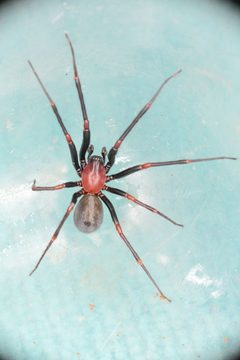
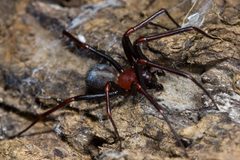
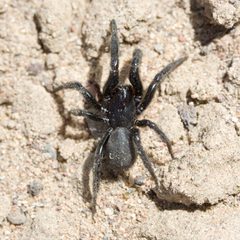
2Plectreuridae is a small, ecribellate, haplogyne spider containing two extant : Plectreurys and Kibramoa. Members are distinguished from related families by possessing eight rather than six. They are hunters that inhabit silken tubes under rocks and dead vegetation. The family has a relict distribution in the southwestern United States, Mexico, and the Caribbean, with fossil evidence indicating a formerly broader range across Europe and Asia.
Pronunciation
How to pronounce Plectreuridae: //plɛkˈtruːrɪˌdeɪ//
These audio files are automatically generated. While they are not always 100% accurate, they are a good starting point.
Identification
Distinguished from closely related (Sicariidae, Scytodidae, Diguetidae, Segestriidae) by having eight rather than six. Females of Plectreurys resemble filistatids but differ in eye arrangement and bowed femurs on the first pair of legs. Males of Plectreurys possess a distinctive stout retrolateral process on the tibia of leg I bearing a strong spine, absent in Kibramoa.
Images
Habitat
Silken tubes constructed under rocks and dead cacti; seldom leave these retreats.
Distribution
Southwestern United States, Mexico, Cuba, Rica, and Caribbean islands. Fossil records from Eocene Baltic amber (Europe), Miocene Dominican amber (Hispaniola), and Jurassic deposits (China).
Seasonality
males wander at night, particularly when mature and searching for females.
Life Cycle
Males leave their silken tubes upon maturity to search for females.
Behavior
hunting spiders that remain in silken tubes; males become susceptible to entrapment in tree resin seeps when wandering to find mates. Males use coupling spurs on leg I tibia to restrain or position females during mating.
Similar Taxa
- FilistatidaeFemales of Plectreurys resemble filistatids in general appearance; distinguished by arrangement and bowed femurs on leg I.
- SegestriidaeSimilar tube-dwelling habit and close phylogenetic relationship; distinguished by eight in Plectreuridae versus six in Segestriidae.