
Tinus peregrinus
Bishop, 1924
nursery web spider
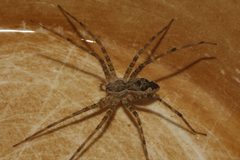
Tinus peregrinus is a small nursery web spider in the Pisauridae, notable for being the smallest member of its family in North America. reach only about 10 mm in body length, with males slightly smaller than females. The occurs across the southwestern United States and northern Mexico, where it inhabits riparian edges and human structures near water. Unlike larger fishing spiders and nursery web spiders, T. peregrinus is rarely encountered due to its diminutive size and cryptic habits.

Pronunciation
How to pronounce Tinus peregrinus: /ˈtiː.nus ˌpɛ.rəˈɡriː.nus/
These audio files are automatically generated. While they are not always 100% accurate, they are a good starting point.
Identification
Distinguished from other North American Pisauridae by its small size (under 10 mm body length), whereas Dolomedes and Pisaurina typically exceed 10–28 mm. The Tinus is the third recognized genus of Pisauridae in North America. Specimens may be mistaken for fishing spiders due to size similarity, but adult Tinus peregrinus can be confirmed by genitalic examination or association with sacs in late summer.
Images
Habitat
Riparian edges near ponds and streams; also found under bark on trees and in human structures such as window frames and pool equipment near water sources. Appears to require proximity to water but not strictly aquatic.
Distribution
Southwestern United States from southern California through southern Nevada, east to Texas and Missouri; northern Mexico. Type locality listed as Hot Springs, Arkansas, though this is suspected to be erroneous.
Seasonality
active year-round in suitable . sacs observed in late July and early August based on preserved collection records.
Life Cycle
sacs produced in late July and early August. Spiderlings emerge from egg sacs carried by female; details of development and longevity unknown.
Behavior
Constructs nursery webs for sac protection. Exhibits site fidelity: individuals remain in established locations for extended periods, evidenced by accumulated shed in webs. Prefers vertical substrates and rarely found on ground. activity suggested by attraction to light and capture of in webs near illuminated buildings.
Ecological Role
of small flying insects, particularly (Chironomidae), based on web contents. Likely contributes to regulation of aquatic emergent insect in riparian .
Human Relevance
Occasionally found in domestic settings near pools and ponds; not considered dangerous to humans. Presence in pool filtration systems and window frames has been documented in Arizona and Texas.
Similar Taxa
- Dolomedes spp.Larger fishing spiders (10–28 mm body length) with more robust build and active hunting on water surface; Tinus peregrinus is smaller and more sedentary.
- Pisaurina spp.Larger nursery web spiders with similar web-building but substantially greater body size; Tinus peregrinus distinguished by size under 10 mm.
- Immature PisauridaeSimilar size to Tinus peregrinus but lack fully developed genitalia and reproductive ; require examination of or for definitive separation.
Misconceptions
Frequently misidentified as fishing spiders due to small size; status confirmed by presence of developed genitalia and sac production.
More Details
Taxonomic history
The Tinus was established by Bishop in 1924 with Tinus peregrinus as the type . The genus remained poorly known until Carico's 1976 revision.
Etymology
Specific epithet 'peregrinus' is Latin for 'wanderer' or 'foreigner', possibly referring to the ' wide geographic range or its initial discovery outside expected range.
Conservation status
Not evaluated; appears common within its restricted range based on iNaturalist observations (768 records) and museum collections.