
Spermophora senoculata
(Dugès, 1836)
shortbodied cellar spider
Spermophora senoculata is a cellar spider ( Pholcidae) native to the Near East that has been introduced to multiple regions worldwide including the USA, southern Europe, China, Korea, and Japan. It is commonly known as the shortbodied cellar spider, a name reflecting its relatively compact body form compared to other pholcids. The has been documented in over 1,200 observations on iNaturalist, indicating its established presence in human-modified environments.
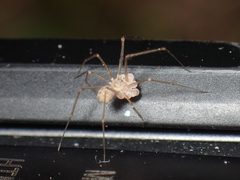
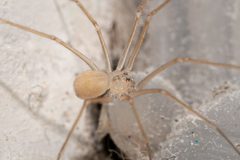
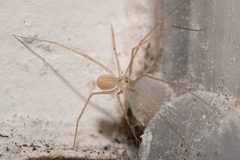
Pronunciation
How to pronounce Spermophora senoculata: /spɛrˈmɒfərə sɛnˌɒkjʊˈleɪtə/
These audio files are automatically generated. While they are not always 100% accurate, they are a good starting point.
Identification
The 'shortbodied cellar spider' suggests a more compact and relative to other cellar spiders, which typically possess extremely elongated, thread-like legs and small bodies. Within Pholcidae, Spermophora generally have shorter legs and less extreme body elongation than the familiar Pholcus phalangioides. Specific diagnostic features for S. senoculata require examination of genital .
Images
Habitat
Documented from human-modified environments; cellar spiders (Pholcidae) as a are strongly associated with dark, humid, sheltered spaces such as cellars, caves, and building interiors.
Distribution
Native to the Near East; introduced and established in the USA, southern Europe, China, Korea, and Japan. GBIF records also document presence in Algeria and Greece.
Human Relevance
An introduced in multiple continents, suggesting human-mediated through trade and transport. Like other cellar spiders, likely occupies building interiors without posing significant nuisance or health risks to humans.
Similar Taxa
- Pholcus phalangioidesThe long-bodied cellar spider has dramatically longer legs and more elongated body; S. senoculata is comparatively short-bodied with more compact proportions.
- Other Spermophora speciesCongeneric share the compact body form but require examination of male and female for definitive identification.
More Details
Taxonomic history
First described by Dugès in 1836, indicating long recognition in arachnological literature.
Invasion biology
The ' documented spread across four continents (North America, Europe, Asia) demonstrates classic anthropogenic patterns typical of spiders.