
Artema atlanta
Walckenaer, 1837
giant daddy-long-legs spider, Giant Cellar Spider
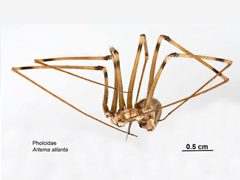
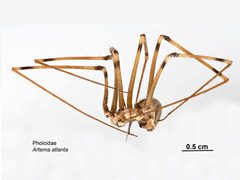
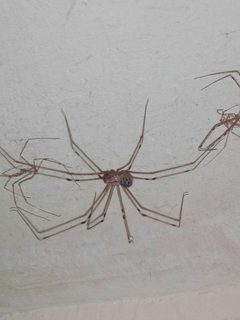
Artema atlanta is a large cellar spider and the largest known pholcid, with a body length of 8–11 mm. It has a pantropical distribution and has been introduced to temperate regions including North America and Europe. The is commonly known as the giant daddy-long-legs spider. It constructs tangled webs in dark, sheltered locations and exhibits characteristic pholcid of rapid, vibrating movement when disturbed.
Pronunciation
How to pronounce Artema atlanta: //ɑːrˈtiːmə ətˈlæntə//
These audio files are automatically generated. While they are not always 100% accurate, they are a good starting point.
Identification
Distinguished from other pholcids by its substantially larger body size (8–11 mm versus typically 2–5 mm for most cellar spiders). The extremely long first pair of legs (6.5× body length) combined with the globose, striped separates it from other large-legged spiders such as harvestmen (Opiliones), which lack the constricted waist between and abdomen. The dark vertical abdominal stripes and male structure provide additional diagnostic characters.
Images
Appearance
Body length 8–11 mm in both sexes, making it the largest pholcid spider. globose with dark vertical lines extending from to surface. First pair of legs roughly 6.5 times body length, producing the characteristic extremely long-legged appearance. Males possess conical enlarged with a distinct process. bear hairs arranged in an S-shaped pattern. Epigynal plate with alternating dark and transparent spots and an indented margin.
Habitat
Occupies dark, sheltered microhabitats including old houses, buildings, feed cattle stores, and similar anthropogenic structures. In tropical regions, found in natural caves and rock crevices. Prefers undisturbed, humid locations with minimal light exposure.
Distribution
Pantropical native distribution spanning tropical Asia, Africa, and the Americas. Recorded from Seychelles, India, Indonesia, Sri Lanka, Vietnam, Brazil, Cuba, Mauritius, Moluccas, and North Africa/Middle East. Introduced to North America (southern Arizona, southeastern California), Belgium, Britain, Greece, Turkey, China, Japan, Taiwan, Australia, and Pacific Islands. First recorded from Iraq (Basrah governorate) in 2017–2018.
Diet
Laboratory observations indicate acceptance of various insects as prey. Natural feeding habits presumed similar to other pholcids, involving capture of small arthropods in tangled webs, though specific prey records from wild are not documented in available sources.
Life Cycle
Females produce spherical sacs approximately 8 mm in diameter containing approximately 66 eggs. Embryonic development requires 25–30 days at laboratory temperatures, with hatching rates of 80–100%. Temperature positively correlates with hatching rate and negatively with development duration. Newly hatched spiderlings measure 1.2 mm in total length. Growth proceeds at approximately 0.1 mm per week, reaching 2 mm total length by week 10. Complete duration and number of instars not documented.
Behavior
Exhibits rapid, vibrating movement of body and legs when disturbed—a characteristic defensive of pholcid spiders. Constructs irregular, tangled webs in sheltered locations. activity pattern presumed based on preference and -level traits, though direct observation not documented.
Human Relevance
Occasional presence in buildings and stored goods; two specimens documented in shipping container arriving in England in 2004. Not known to pose medical significance. Presence in human structures largely unnoticed due to secretive habits.
Similar Taxa
- Pholcus phalangioidesShares Pholcidae and long-legged appearance, but substantially smaller (body length ~7 mm versus 8–11 mm) with different abdominal patterning.
- Opiliones (harvestmen)Superficially similar extremely long legs, but harvestmen lack the constricted (waist) between and , have body regions, and are arachnids of a separate order.
More Details
Laboratory rearing
Successfully maintained in laboratory conditions on diets of various insects; temperature manipulation affects embryonic development rate and hatching success.
Taxonomic note
First described from Brazil in 1837, though presumed native to Old World tropics based on current distribution patterns.
Sources and further reading
- BugGuide
- Wikipedia
- GBIF taxonomy match
- iNaturalist taxon
- NCBI Taxonomy
- Catalogue of Life
- When Harry (Hoogstraal) Met Bill (Reisen) | Bug Squad
- Jackson Audley: Targeting the Walnut Twig Beetle | Bug Squad
- CDC Internship, Fellowship Program Enlightens Mentors and Mentees Alike
- Bug Eric: Eyed Elaters
- Three new mini thorn snail species | Blog
- How One Entomologist Found Her Place in Public Health
- First record of the spider Artema atlanta Walckenaer, 1837 (Araneae: Pholcidae) from Iraq, with references to some its biological aspects