
Artema
Walckenaer, 1837
Giant Cellar Spiders
Species Guides
1- Artema atlanta(giant daddy-long-legs spider)
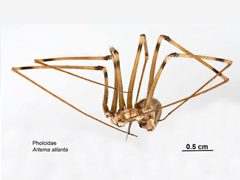
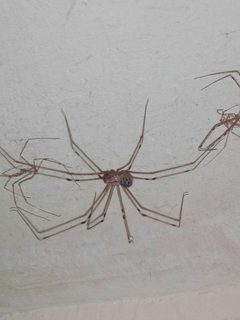
Artema is a of cellar spiders ( Pholcidae) first described by Charles Athanase Walckenaer in 1837. The genus includes some of the largest pholcid spiders and is primarily distributed from West Africa through Central Asia to Pakistan. One , A. atlanta, has been introduced worldwide. The genus comprises twelve recognized species as of October 2025.
Pronunciation
How to pronounce Artema: //ˈɑr.tə.mə//
These audio files are automatically generated. While they are not always 100% accurate, they are a good starting point.
Identification
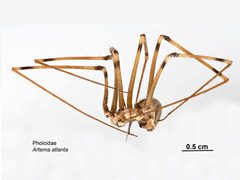
Artema are distinguished from other pholcid by their notably large body size. Males possess conical enlarged bearing a process, and with hairs arranged in an S-shaped pattern. The is globose with dark vertical lines extending from top to bottom. The epigynal plate in females shows dark and transparent spots with an indented margin. A. martensi is the largest known pholcid species by male width.
Images
Habitat
Natural include caves and subterranean environments; A. martensi occurs in caves in the western Anti-Atlas of Morocco but is not troglomorphic. of A. atlanta inhabit old houses, buildings, and feed cattle stores.
Distribution
Native range extends from West Africa through Central Asia, the Middle East, the Arabian Peninsula, and the eastern Mediterranean to Pakistan. A. martensi represents the northwestern African limit in Morocco. A. atlanta has been introduced globally.
Diet
Laboratory observations indicate on various insects, though natural prey preferences remain undocumented.
Life Cycle
Females produce spherical sacs approximately 8 mm in diameter containing about 66 eggs. Embryonic development requires 25–30 days at laboratory temperatures, with hatching rates of 80–100%. Temperature positively correlates with hatching rate and negatively with development duration. Newly hatched spiderlings measure 1.2 mm and grow approximately 0.1 mm weekly, reaching 2 mm total length by week 10.
Human Relevance
A. atlanta is a associated with human structures in its native range and has been introduced worldwide, though specific impacts or benefits to humans are not documented.
Similar Taxa
- Other Pholcidae generaArtema are substantially larger than most cellar spiders; male width in A. martensi exceeds that of all other known pholcids.
More Details
Body Size Evolution
Comparative analysis of 1,632 pholcid demonstrates that Artema includes the largest members of the . Long-term data show a trend of decreasing mean body size among newly described pholcid species over 50-year and 20-year periods, making Artema's large size increasingly exceptional.
Sources and further reading
- BugGuide
- Wikipedia
- GBIF taxonomy match
- iNaturalist taxon
- NCBI Taxonomy
- Catalogue of Life
- First record of the spider Artema atlanta Walckenaer, 1837 (Araneae: Pholcidae) from Iraq, with references to some its biological aspects
- First Northwest African species of the spider genus Artema, from caves in Morocco, with notes on body size in pholcid spiders (Araneae: Pholcidae)
- Poly(ARTEMA), a novel artesunate-based polymer induces ferroptosis in breast cancer cells.