
Rhysodromus
Schick, 1965
Species Guides
3- Rhysodromus alascensis
- Rhysodromus histrio(Attractive Running Crab Spider)
- Rhysodromus mysticus
Rhysodromus is a of running crab spiders in the Philodromidae, established by Schick in 1965. The genus contains 28 recognized distributed across North America, Europe, Asia, and parts of Africa. Members are characterized by their laterigrade leg posture, enabling sideways movement. Many species inhabit arid and semi-arid environments, with several showing adaptations to saline or xeric conditions.
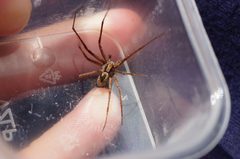
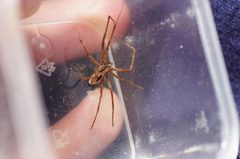
Pronunciation
How to pronounce Rhysodromus: //raɪsəˈdroʊməs//
These audio files are automatically generated. While they are not always 100% accurate, they are a good starting point.
Identification
Rhysodromus can be distinguished from other Philodromidae by genitalic characters, particularly male palpal and female epigynal structure. The genus lacks the pronounced body flattening seen in some related genera. Species-level identification requires examination of copulatory organs and often relies on geographic distribution as an additional criterion.
Images
Habitat
range from temperate forests to arid steppes and semi-deserts. Several are associated with saline environments: R. halophilus and R. sinaiticus occur in salt marsh habitats, while R. xerophilus and R. petrobius inhabit xeric rocky areas. The shows notable diversity in Central Asian steppe and desert .
Distribution
Holarctic distribution with strong representation in the Palearctic. Primary diversity centers include Central Asia (Kazakhstan, Mongolia), Russia (Siberia to Far East), and China. European include R. fallax and R. histrio. North American records comprise R. alascensis, R. histrio, and R. mysticus. Isolated occur on the Canary Islands, Cape Verde, St. Helena, and the Mediterranean basin.
Behavior
Laterigrade leg orientation permits characteristic sideways scuttling movement. Several have been observed occupying ground debris and low vegetation rather than the arboreal typical of many Philodromidae.
Similar Taxa
- PhilodromusLarger and more -rich in the same ; Rhysodromus species often occupy more xeric and differ in genitalic
- TibellusShares laterigrade posture but has more elongated body form and different arrangement; Rhysodromus typically has stouter body proportions
More Details
Taxonomic History
The was erected to accommodate previously placed in Philodromus that showed distinct genitalic . Several species were transferred to Rhysodromus in 2008 based on revisions by Szita & Logunov.
Conservation Status
No in the have been evaluated by the IUCN. The restricted-range island endemics (R. hierroensis, R. petrobius, R. signatus) may warrant assessment due to limited distributions.