
Philodromus dispar
Walckenaer, 1826
Eurasian Running Crab Spider
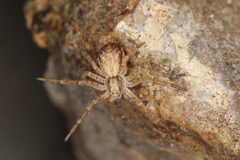
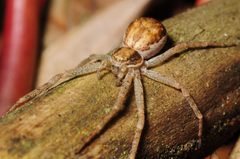
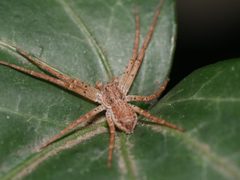
Philodromus dispar is a small running crab spider native to Eurasia that has been introduced to North America. It is an active hunter that does not build webs, instead ambushing prey on vegetation. The exhibits pronounced in coloration: males are shiny black or dark brown with white margins, while females are highly variable in size and color. Its attachment ability depends on ambient humidity, with optimal adhesion at intermediate humidity levels.
Pronunciation
How to pronounce Philodromus dispar: //ˌfɪloʊˈdroʊməs ˈdɪspɑr//
These audio files are automatically generated. While they are not always 100% accurate, they are a good starting point.
Identification
Distinguished from native North American Philodromus by its introduced status and specific male coloration (shiny black with white edges). Females are difficult to identify due to high variability and require careful examination. Distinguished from the infuscatus group (native to the Americas) by geographic origin and morphological details; P. dispar is the sole American representative of the dispar group. Running crab spiders in general can be separated from true crab spiders (Thomisidae) by their laterigrade leg orientation and flattened body profile.
Images
Appearance
Small spider approximately 5 mm in body length. Males are shiny and iridescent black or dark brown with distinct white edges on the and . Females are highly variable in both size and coloration, ranging from light to dark shades without the consistent patterning seen in males. The possesses hairy attachment pads (setae) on its that enable adhesion to smooth surfaces.
Habitat
Arboreal and shrub-dwelling; found on trees and bushes. Occupies woody vegetation in both natural and human-modified environments.
Distribution
Native to Europe, Turkey, the Caucasus, Russia (European part to South Siberia), and Iran. Introduced to North America, with established in the United States and Canada. Also recorded from Flanders, Belgium.
Diet
Active of flies and other small insects. Does not construct capture webs.
Behavior
Agile, hunter that relies on speed and ambush rather than web-building. Remains stationary on vegetation to await prey, then pursues it actively. Attachment ability to smooth surfaces varies with humidity: adhesion is strongest at intermediate relative humidity (approximately 50-70%), weaker in dry conditions, and substantially reduced at high humidity due to water condensation on surfaces.
Ecological Role
in arboreal and shrub .
Human Relevance
Introduced in North America; subject of biomechanical research on dry adhesion mechanisms. Not known to be of economic or medical importance.
Similar Taxa
- Philodromus infuscatus groupNative American group comprising 20 species and 2 ; P. dispar is the sole introduced representative of the dispar group in the Americas, distinguished by Old World origin and male coloration
More Details
Biomechanical research significance
P. dispar has been used as a model organism for studying humidity-dependent adhesion in 'dry' adhesive systems. Its attachment setae operate via van der Waals forces modified by capillary effects at intermediate humidity, with performance declining at both low and high humidity extremes.
Taxonomic note
The dispar group is primarily Palearctic in distribution; P. dispar represents the only member of this group established in the Americas, where it occurs alongside the diverse native infuscatus group.
Sources and further reading
- BugGuide
- Wikipedia
- GBIF taxonomy match
- iNaturalist taxon
- NCBI Taxonomy
- Catalogue of Life
- It Flies! Regulatory Officials on Constant Alert for Flighted Spongy Moths
- The influence of humidity on the attachment ability of the spiderPhilodromus dispar(Araneae, Philodromidae)
- THE INFUSCATUS AND DISPAR GROUPS OF THE SPIDER GENUS PHILODROMUS IN NORTH AND CENTRAL AMERICA AND THE WEST INDIES (ARANEIDA: THOMISIDAE)