
Ebo pepinensis
Gertsch, 1933
running crab spider
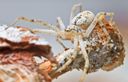
Ebo pepinensis is a of running crab spider in the Philodromidae, first described by Gertsch in 1933. It is a small spider with a body length of 2–6 mm, characterized by its extremely elongated second pair of legs that are at least twice as long as the other legs. The species is found across the United States and southern Canada. Like other philodromids, it is an active hunter that prowls for prey among grasses and foliage rather than building webs to capture food.
Pronunciation
How to pronounce Ebo pepinensis: /ˈiː.boʊ pɛˈpɪ.nɛn.sɪs/
These audio files are automatically generated. While they are not always 100% accurate, they are a good starting point.
Identification
Members of the Ebo are distinguished from other running crab spiders by their extremely elongated second pair of legs, which are at least twice the length of all other legs. This gives them the greatest 'wingspan' relative to body size of any North American spider. The body is small and flattened, averaging 2–6 mm in length. Philodromidae as a can be recognized by the laterigrade leg orientation (legs twisted at the base to extend horizontally, allowing the spider to move sideways), and specifically by having the second pair of legs longest rather than the first pair as in the related crab spider family Thomisidae.
Images
Distribution
Found in the United States and Canada. Specific Canadian provincial records include Alberta, British Columbia, and Manitoba. The Ebo reaches its greatest diversity in the southwestern United States.
Similar Taxa
- TitaneboSeveral formerly placed in Ebo have been reassigned to the Titanebo, making field identification between these genera difficult without detailed examination. Both share the characteristic of elongated second legs and similar overall body form.
- Other PhilodromidaeEbo is distinguished from other running crab spiders by the extreme elongation of the second leg pair. Other in the have proportionally shorter second legs.
Sources and further reading
- BugGuide
- Wikipedia
- GBIF taxonomy match
- iNaturalist taxon
- Catalogue of Life
- Ebony Grasshopper
- New eBook: The American Entomologist Poet's Guide to the Orders of Insects
- Bug Eric: January 2012
- social insects | Blog
- Bug Eric: Stealing Minds and Destroying Morale: LibGen, Meta, and AI
- December | 2022 | Beetles In The Bush