
Sosippus
Simon, 1888
funnel web wolf spiders
Species Guides
6- Sosippus californicus(Funnel-web wolf spider)
- Sosippus floridanus(funnel-web wolf spider)
- Sosippus janus(Funnel-web Wolf Spider)
- Sosippus mimus(funnel-web wolf spider)
- Sosippus placidus(Lake Placid Funnel Wolf Spider)
- Sosippus texanus
Sosippus is a of web-building wolf spiders in the Lycosidae, distinguished by its unusual habit of constructing large funnel-webs similar to those of funnel-web weavers in the family Agelenidae. Unlike the nomadic hunting typical of most lycosids, members of this genus are sedentary web-dwellers. The genus is found from the southern United States through Mexico to Central America. Females exhibit extended maternal care, with spiderlings remaining on the mother's web for months after hatching.


Pronunciation
How to pronounce Sosippus: //sɒˈsɪpəs//
These audio files are automatically generated. While they are not always 100% accurate, they are a good starting point.
Identification
Distinguished from other Lycosidae by the combination of web-building and elongate . Most easily confused with Agelenidae (true funnel-web weavers), which construct nearly identical webs. Key distinguishing feature is arrangement: Sosippus has the characteristic lycosid pattern with two large posterior eyes prominently positioned above four small eyes, whereas Agelenidae have eyes of more uniform size in a compact grouping. The elongate posterior spinnerets are also diagnostic for the .
Images
Appearance
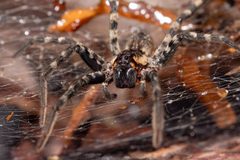
Medium to large wolf spiders with body lengths ranging from approximately 13-18 mm. The are noticeably more elongate than in other Lycosidae. The arrangement consists of three rows: four small eyes in the lowest row, two large posterior eyes in the middle row, and two smaller posterior lateral eyes flanking the large median pair. This eye pattern distinguishes them from Agelenidae, which have more compact eye arrangements with eyes of relatively equal size.
Habitat
Constructs sheet-like funnel webs sprawling over vegetation such as cacti, agave, and palmetto, or anchored in rock crevices. S. californicus is most abundant in riparian situations, living at edges of stream corridors and wetland . S. floridanus occupies forest hammocks in Florida. Habitat associations vary by : S. floridanus is a widespread , while S. placidus is a narrow .
Distribution
Ranges from Central America northward through Mexico to the southern United States. Documented U.S. records include southern California, Arizona, Texas, and Florida. -specific distributions: S. agalenoides (Mexico to Rica), S. californicus (southern California to Arizona, south through Mexico to Costa Rica), S. floridanus (Florida), S. janus (USA), S. mexicanus (Mexico, Guatemala), S. michoacanus (Mexico), S. mimus (USA), S. placidus (USA), S. plutonus (Mexico), S. texanus (Texas).
Host Associations
- Mantispa sayi - S. texanus is a recorded ; mantisfly larvae consume spider
Life Cycle
Females produce sacs that are tethered to the and carried until spiderlings hatch. Spiderlings then ride on the mother's back until their next , after which they share her web. Extended maternal care continues for several months, with mothers observed feeding offspring in S. floridanus.
Behavior
Unique among Lycosidae for constructing large, permanent funnel-webs rather than hunting nomadically. Exhibits subsocial with extended maternal care and cooperative interactions among offspring. Spiderlings may coexist on the maternal web for months. In captivity, older spiders can coexist in confined spaces if regularly fed.
Ecological Role
Web-building ; occupies similar to Agelenidae in regions where both occur. Subsocial may influence local through extended groups.
Similar Taxa
- AglaoctenusClosest relatives; both belong to Hippasinae and share web-building
- AgelenidaeConvergent web architecture produces nearly identical funnel-webs; distinguished by arrangement and
More Details
Geographic recency
of Sosippus appear to have diverged relatively recently in geologic time
Captivity behavior
Older spiders have been observed coexisting in confined spaces when regularly fed, suggesting beyond typical solitary lycosid
Sources and further reading
- BugGuide
- Wikipedia
- GBIF taxonomy match
- iNaturalist taxon
- NCBI Taxonomy
- Catalogue of Life
- Bug Eric: Spider Sunday: Funnel-web Wolf Spiders
- Habitat associations of the web-building wolf spiders Sosippus floridanus and Sosippus placidus (Lycosidae: Sosippinae): a widespread generalist versus an endemic specialist
- Subsocial Behavior in the Funnel-Web Wolf Spider Sosippus floridanus (Araneae: Lycosidae)