
Oreonetides
Strand, 1901
dwarf spiders
Species Guides
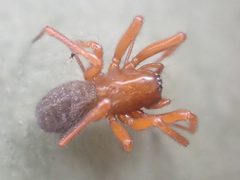
1- Oreonetides vaginatus(Undergrowth Sheet-web Weaver)
Oreonetides is a of dwarf spiders in the Linyphiidae, first described by Embrik Strand in 1901. The genus contains 17 described distributed across the Northern Hemisphere, with records from North America, Europe, Russia, and East Asia. Species occupy diverse ranging from and alpine regions to temperate forests. The type species, Oreonetides vaginatus, has the broadest distribution, spanning from North America across Eurasia to Japan.
Pronunciation
How to pronounce Oreonetides: /ˌɔːr.iː.əʊ.nɪˈtiː.deɪz/
These audio files are automatically generated. While they are not always 100% accurate, they are a good starting point.
Images
Habitat
have been documented in forests, alpine zones, and temperate woodland . Several species are associated with cold-adapted environments: O. glacialis occurs in glacial or high-elevation areas in Europe, while O. beringianus and O. badzhalensis inhabit the Russian Far East and eastern Siberia. North American species occupy forest floor and understory microhabitats typical of linyphiid spiders.
Distribution
Holarctic distribution spanning North America (USA, Canada), Europe, and Asia (Russia from European part to Far East, Japan, Taiwan). Individual show varying ranges: O. vaginatus is trans-Palearctic and Nearctic; O. quadridentatus is restricted to Western Europe (Belgium, Germany, Austria); O. taiwanus is to Taiwan; O. shimizui occurs in Russia and Japan.
More Details
Type species
Oreonetides vaginatus (Thorell, 1872), originally described as Erigone vaginata. This has the widest distribution in the , recorded across North America, Europe, and northern Asia including Japan.
Taxonomic history
The was established by Norwegian arachnologist Embrik Strand in 1901. Several were transferred from other genera, particularly Erigone (e.g., O. vaginatus, O. flavus, O. rectangulatus, O. rotundus). Species described by Russian arachnologist Yuri M. Eskov in 1984 and 1991 account for nearly half the genus diversity.