
Neriene montana
(Clerck, 1757)
Old World Dome Sheetweaver
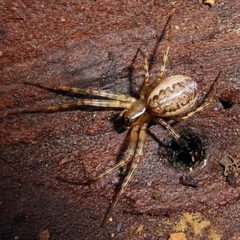
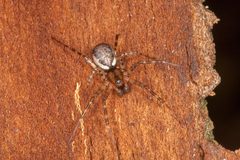
Neriene montana is a small sheetweb-weaving spider in the Linyphiidae, formerly known as Linyphia montana. It has a holarctic distribution spanning northern Europe, Russia, Central Asia, and Japan. The constructs distinctive hammock-shaped webs and is commonly found in vegetation, under logs, and on tree trunks. It is one of the more frequently observed linyphiid spiders, with over 3,400 records on iNaturalist.
Pronunciation
How to pronounce Neriene montana: //nɛˈriː.niː.e mɒnˈtɑː.nə//
These audio files are automatically generated. While they are not always 100% accurate, they are a good starting point.
Identification
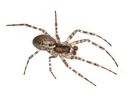
Distinguished from similar Neriene by the combination of small size (4–7 mm), yellow-brown legs with prominent annulations, and the abdominal pattern of a brown folium with pale speckles and indentations on a pale background. The and male provide definitive identification but require microscopic examination. specimens cannot be reliably identified to species.
Images
Habitat
Builds webs among bushes or low vegetation, on tree trunks, and under logs. Occupies a variety of wooded and semi-open including forest clearings, parklands, and montane areas.
Distribution
Holarctic: northern Europe, Caucasus, Russia (European to Far East), Central Asia, and Japan. Present in Flanders, Belgium.
Behavior
Constructs a hammock-shaped (dome) sheet web, positioned beneath which the spider rests while waiting for prey. Web architecture is characteristic of the .
Ecological Role
of small flying and crawling insects captured in its sheet web. Serves as prey for larger and vertebrates.
Human Relevance
No documented economic or medical significance. Occasionally encountered by naturalists and arachnologists due to its widespread distribution.
Similar Taxa
- Other Neriene speciesSimilar body plan and web architecture; distinguished by leg annulation pattern, abdominal markings, and genitalic structures
More Details
Sources and further reading
- BugGuide
- Wikipedia
- GBIF taxonomy match
- iNaturalist taxon
- NCBI Taxonomy
- Catalogue of Life
- Bumble Bee Mellowing Out on the Mallow | Bug Squad
- Little Spurthroated Grasshopper
- Study Identifies Areas in U.S. Most Suitable for Invasive Giant Hornet
- Cattle Grazing Helps Pollinators in Sagebrush Rangelands
- Cicadas Race to Catch Up With Their Evolving Endosymbionts
- Bug Eric: Spider Sunday: Spider Sex Ed