
Drapetisca
Menge, 1866
sheetweb weavers
Species Guides
1- Drapetisca alteranda(Northern Long-toothed Sheetweaver)
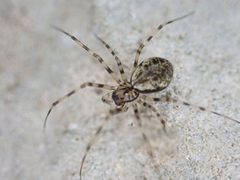
Drapetisca is a of dwarf sheetweb spiders in the Linyphiidae, first described by Anton Menge in 1866. Members are exceptionally small, with females measuring 4–5 mm and males 3–4 mm in body length. These spiders are highly specialized tree trunk dwellers that construct minimal, nearly invisible sheet webs. The genus currently comprises approximately 7 distributed across the Holarctic region, including North America, Europe, Asia, and Japan.
Pronunciation
How to pronounce Drapetisca: //dræpəˈtɪskə//
These audio files are automatically generated. While they are not always 100% accurate, they are a good starting point.
Identification
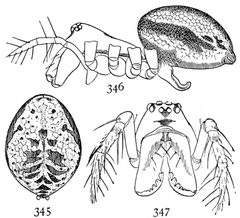
Drapetisca can be distinguished from other Linyphiidae by the anchor-shaped palpal arm of the paracymbium in males (retrolateral view) and the protruding epigyne lacking a scape in females. In the field, the combination of tiny size, tree trunk , sprawling posture on an almost invisible web, and activity separates it from active hunting spiders like lynx spiders (Oxyopidae) that may occur in similar microhabitats. Definitive identification requires microscopic examination of genitalic structures.
Images
Habitat
Specialized for vertical tree trunk surfaces in forested environments. Occurs on bark of living trees where it constructs minimal sheet webs. In North America, found in deciduous and mixed forests. One Chinese (D. dentata) described from subtropical evergreen broad-leaved forest at 590 m elevation.
Distribution
Holarctic distribution. recorded from Canada, USA (northern tier states, Great Lakes region, Montana, New England), Europe, Caucasus, Russia (Europe to Far East), Central Asia, China, and Japan. Drapetisca alteranda occurs in southern Canada and extreme northern USA, including New England, Great Lakes region, Montana, Alberta, and British Columbia. D. socialis, the type , has the broadest range across Europe and Asia.
Seasonality
active from July to September in northern temperate regions. activity pattern.
Diet
Predatory; feeds on insects and smaller spiders that contact the web or come within reach on tree trunks.
Behavior
. Constructs extremely thin, minimal sheet webs on vertical tree trunks rather than the extensive sheet webs typical of many Linyphiidae. Sits motionless in a sprawling posture, appearing to rest directly on bark while actually suspended on the web. This hunting strategy blends elements of web-building and ambush .
Ecological Role
in forest and trunk microhabitats. Contributes to regulation of small arthropod on tree bark surfaces.
Human Relevance
No economic importance. Occasionally encountered by naturalists and arachnologists studying forest spider . Not a pest or beneficial in agricultural or urban contexts.
Similar Taxa
- Oxyopidae (lynx spiders)Active hunting spiders that may occur on tree trunks and vegetation; distinguished by spiny legs, forward-directed , and absence of web-building
- Other LinyphiidaeMost construct more extensive sheet webs in vegetation or leaf litter rather than minimal webs on vertical bark; differ in body proportions and web architecture
More Details
Taxonomic history
The was established by Anton Menge in 1866 with Drapetisca socialis as type . A 2025 taxonomic revision recognized 7 species globally, with 5 species recorded from China. D. dentata was described as new from Chongqing, China in 2025.
Research gaps
and natural history remain poorly documented for most due to small size, cryptic habits, and lack of economic importance. Basic information on , development, and is largely unknown.
Sources and further reading
- BugGuide
- Wikipedia
- GBIF taxonomy match
- iNaturalist taxon
- NCBI Taxonomy
- Catalogue of Life
- Bug Eric: Sheetweb weaver, Drapetisca alteranda
- Bug Eric: April 2014
- One new species of Drapetisca Menge, 1866 (Araneae, Linyphiidae) from Gele Mountain, Chongqing, China
- Microhabitat distribution ofDrapetisca alteranda, a tree trunk specialist sheet web weaver (Araneae: Linyphiidae)