
Talanites
Simon, 1893
Species Guides
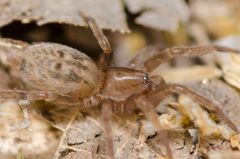
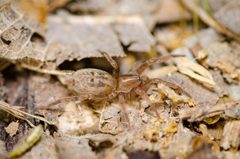
2Talanites is a of ground spiders in the Gnaphosidae, established by Eugène Simon in 1893. The genus contains fifteen described distributed across arid and semi-arid regions of North America, the Mediterranean, Central Asia, and South Asia. Members are ground-dwelling hunters with a flattened body form typical of the family. The genus shows a disjunct distribution pattern with species in both the New World and Old World.
Pronunciation
How to pronounce Talanites: /tæˈlænaɪtiːz/
These audio files are automatically generated. While they are not always 100% accurate, they are a good starting point.
Identification
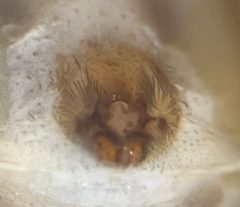
Talanites are distinguished from other Gnaphosidae by a combination of genitalic characters, particularly the structure of the male palpal bulb and female . The arrangement follows the typical gnaphosid pattern with two rows of four eyes each. Species-level identification requires examination of reproductive structures and is not reliably accomplished from external alone.
Images
Habitat
occur in arid and semi-arid environments including deserts, steppes, and dry grasslands. Several species are known from caves (e.g., T. cavernicola). The shows to xeric conditions across its range.
Distribution
Disjunct distribution: North America (southern Texas, California, southeastern United States), Mexico, Mediterranean region (Egypt, Israel, Tunisia, Azerbaijan), Central Asia (Kazakhstan, Georgia), Ukraine, Russia, India, Pakistan, and Myanmar.
Similar Taxa
More Details
Species Diversity
The includes fifteen described as of 2019, with notable concentrations in Central Asia and the southwestern United States. Several species have restricted distributions, including cave- .
Taxonomic History
The has been subject to revision by Platnick and Ovtsharenko (1991), who described multiple new and clarified boundaries with related genera.