
Xeropigo
O. Pickard-Cambridge, 1882
Species Guides
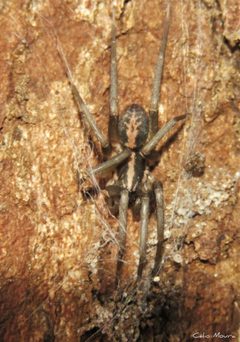
1Xeropigo is a of sac spiders in the Corinnidae, first described by O. Pickard-Cambridge in 1882. The genus comprises 17 described distributed across South America and the Caribbean, with the majority of species occurring in Brazil. Recent taxonomic revisions have significantly expanded the known diversity, with seven new species described from Brazil in 2016. The genus shows notable in northeastern Brazilian states, particularly Piauí, Ceará, and Maranhão.


Pronunciation
How to pronounce Xeropigo: /zɛ.roˈpi.go/
These audio files are automatically generated. While they are not always 100% accurate, they are a good starting point.
Identification
The can be distinguished from other Corinninae by genitalic , particularly the structure of the male pedipalpal bulb and female . A diagnostic key to all is available in taxonomic literature. Species-level identification requires examination of reproductive structures and is not feasible from external morphology alone.
Images
Habitat
Most have been collected from tropical and subtropical terrestrial in Brazil. Xeropigo canga has been documented from canga vegetation (open, rocky savanna with herbaceous and shrubby plants on iron-rich substrates) in Minas Gerais. Several northeastern Brazilian species occur in Caatinga-associated regions. Specific microhabitat preferences remain undocumented for most species.
Distribution
South America and Caribbean: Brazil (primary center of diversity with 15+ ), Bolivia, Peru, Guyana, Venezuela, Trinidad, Cayman Islands, and United States (southern). Xeropigo tridentiger, the type species, has the broadest range extending from the southern United States through the Caribbean to Brazil and St. Helena.
Similar Taxa
- CorinnaBoth belong to Corinninae and share general body plan; Xeropigo typically have more complex male pedipalpal bulb with distinctive embolic structures
- MegalostrataAnother Corinninae with overlapping Neotropical distribution; Xeropigo lacks the characteristic abdominal patterning seen in many Megalostrata