
Neoscona domiciliorum
(Hentz, 1847)
Red-femured Spotted Orbweaver, Spotted Orbweaver, Redfemured Spotted Orbweaver
Neoscona domiciliorum is a medium-sized orbweaver spider to the eastern and southeastern United States. The name 'domiciliorum' (Latin for 'of dwellings') reflects its frequent occurrence on buildings, though it also inhabits moist woodlands. Females construct large vertical orb webs up to 50 cm in diameter, typically building at dusk and dismantling before dawn. The spider is recognized by distinctive coloration including red on the legs and a pale cruciform pattern on the .
Pronunciation
How to pronounce Neoscona domiciliorum: /niːˈɒskəʊnə ˌdɒmɪˈsɪliˌɔːrəm/
These audio files are automatically generated. While they are not always 100% accurate, they are a good starting point.
Identification
Distinguished from by the combination of red and the specific abdominal pattern (pale cruciform marking with black lateral stripes). The longitudinal groove on the separates Neoscona from Araneus . pattern of four white spots on dark background with red abdominal tip is consistent and useful for identification. Females are larger and more robust than males, which have reduced, linear .
Images
Appearance
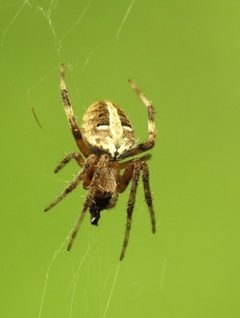
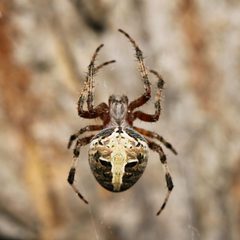
display a bright white or yellow marking on the , flanked by broad black lateral stripes and a thin transverse white band anteriorly, forming a pale cruciform shape. The first leg segment () is red, with remaining segments banded in black and pale gray. The abdomen is dark with four white spots and a red tip. Females measure 7–16 mm in body length with sparse short gray hairs; males are smaller (~8 mm) with a relatively small, linear abdomen. A longitudinal groove on the is characteristic of the Neoscona.
Habitat
Primarily found in moist hardwood woodlands, especially in autumn. Frequently occurs on buildings, particularly under eaves, where it may be overlooked due to habits. Webs are placed vertically in trees, shrubs, or on artificial structures. Retreats constructed of leaves or debris bound with silk are positioned near frame lines for daytime use.
Distribution
to the United States, occurring southeast of a line connecting Texas, Indiana, and Massachusetts. Core range includes the southeastern and mid-Atlantic states.
Seasonality
are most conspicuous in autumn; females remain active in moist Florida woodlands throughout the fall season. spiders likely overwinter, with adult activity diminishing after first hard frosts.
Diet
Feeds on flying insects intercepted in orb webs, including , flies, and other insects attracted to lights.
Life Cycle
Females construct sacs late in the season, depositing up to 1,000 eggs in a spherical mass covered with fluffy yellow silk, typically concealed in a rolled leaf. Spiderlings emerge in spring. One per year in temperate regions.
Behavior
; females build webs at dusk and typically dismantle them before daybreak, though webs may be left intact later in the season when nutritional demands for production are higher. At night, the spider occupies the hub of the web and responds to vibrations. During the day, it retreats to a silken-bound shelter of leaves or debris. Males cease web-building upon sexual maturity and actively wander in search of females.
Ecological Role
of flying insects; contributes to natural pest control in woodland and suburban . Webs are frequently replaced, with silk recycled by consumption.
Human Relevance
Beneficial for controlling insect pests around homes and buildings. Bites are not known to cause serious harm to humans. Often unnoticed due to habits and retreat during daylight hours.
Similar Taxa
- Neoscona cruciferaOverlaps in eastern range and shares 'spotted orbweaver' ; distinguished by more variable pattern without consistent red and different abdominal markings
- Araneus cavaticusShares 'barn spider' and similar size; separated by closed web hub (vs. open in Neoscona) and lack of longitudinal groove
More Details
Web Architecture
Unlike Araneus , the web hub remains open with only one or two crossing threads. Frame lines may extend to the ground or surrounding vegetation, with webs reaching 50 cm in diameter.
Etymology
The specific epithet domiciliorum directly references the ' association with human dwellings, a notable behavioral trait among orbweavers.
Sources and further reading
- BugGuide
- Wikipedia
- GBIF taxonomy match
- iNaturalist taxon
- NCBI Taxonomy
- Catalogue of Life
- Arachnid Alert! 'Powerhouse' of Arachnologists to Greet Public at Bohart Museum Open House | Bug Squad
- Why You Should Love Spiders--Or at Least Like Them! | Bug Squad
- Bug Eric: Spider Sunday: Western Spotted Orbweaver
- Bug Eric: Spider Sunday: Sixspotted Orbweaver
- Bug Eric: Spider Sunday: Hentz's Orbweaver
- orb weavers | Beetles In The Bush