
Mangora placida
(Hentz, 1847)
Tuft-legged Orbweaver
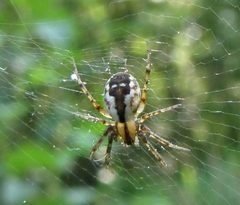
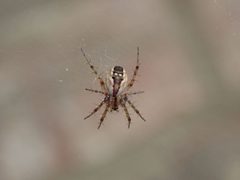
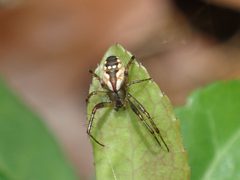
Mangora placida is a small orb-weaving spider in the Araneidae, commonly known as the Tuft-legged Orbweaver. It is found across North America, with records from Canada through the United States. The is notable for the tufted projections on its legs, a distinctive feature referenced in its . Juveniles and build vertical orb webs to capture flying insects.
Pronunciation
How to pronounce Mangora placida: /mæŋˈɡɔːrə ˈplæsɪdə/
These audio files are automatically generated. While they are not always 100% accurate, they are a good starting point.
Identification
Mangora placida can be distinguished from other Mangora by the presence of distinct tuft-like projections on the legs. It builds a vertical orb web, which separates it from the Orchard Orbweaver (Leucauge venusta) that constructs horizontal orb webs. The species may be confused with other small Araneidae, but the leg tufts are diagnostic.
Images
Habitat
Found in a variety of including woodlands, gardens, and residential areas. Builds webs in vegetation, with juveniles often constructing webs closer to the ground and placing them higher in shrubs and bushes.
Distribution
North America, including Canada (Alberta, Manitoba) and the United States. Records extend across much of the continent.
Seasonality
are most abundant in late spring and early summer. Individuals overwinter as sub-adults, hiding in leaf litter and under loose bark.
Diet
Feeds on flying insects captured in its orb web, including small flies, gnats, and other aerial arthropods.
Life Cycle
Overwinters as sub-. Matures in spring and early summer, with adults present during this period. sacs are produced during the adult stage.
Behavior
Constructs and maintains a vertical orb web. When threatened, drops from the web to the ground and seeks in leaf litter. Web is typically removed and rebuilt regularly.
Ecological Role
of small flying insects; contributes to regulation of of aerial arthropods in its .
Human Relevance
Generally harmless to humans. Occasionally encountered in gardens and residential areas where its webs may be noticed. Not considered a pest .
Similar Taxa
- Leucauge venusta (Orchard Orbweaver)Builds horizontal orb webs rather than vertical ones; lacks leg tufts; has more elaborate color pattern with green legs.
- Other Mangora speciesMay be distinguished by the presence or absence of leg tufts and specific abdominal patterning.
Sources and further reading
- BugGuide
- Wikipedia
- GBIF taxonomy match
- iNaturalist taxon
- NCBI Taxonomy
- Catalogue of Life
- sectiliclava_placidae_myartseva_et_al._holotype_female_ucrc_ent_125325_lateral.jpg | Entomology Research Museum
- Primary Type List | Entomology Research Museum
- Publications | Entomology Research Museum
- Bug Eric: Grand Finale
- Bug Eric: 2024
- Bug Eric: Spider Sunday: Orchard Orbweaver