
Cyrtophora
Simon, 1895
tent-web spiders, tentweb weavers
Species Guides
1- Cyrtophora citricola(Tropical Tent-web Spider)
Cyrtophora is a of tent-web spiders in the Araneidae. Despite being classified as orb-weavers, these spiders construct horizontal, tent-like non-sticky webs rather than traditional orb webs. Many exhibit colonial , with multiple individuals sharing extensive web structures. The genus is distributed across tropical and subtropical regions worldwide, with some species introduced to new areas. Females typically reach about 10 mm in body length.
Pronunciation
How to pronounce Cyrtophora: //sɜːrˈtɒfərə//
These audio files are automatically generated. While they are not always 100% accurate, they are a good starting point.
Identification
Distinguished from other Araneidae by their non-sticky, horizontal tent webs rather than vertical orb webs. Can be separated from the unrelated Cyrtarachne (also called tent-web spiders) by morphological characters and web architecture details. Colonial web are a strong indicator, though not all are colonial.
Images
Appearance
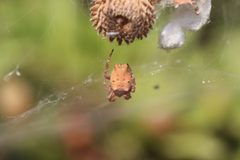
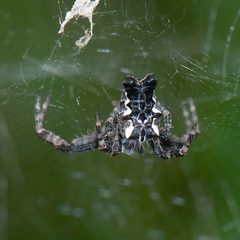
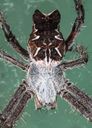
Females have a body length of approximately 10 mm. Some , including Cyrtophora cicatrosa, exhibit rapid color-changing ability. The shows considerable morphological diversity across its 44+ species.
Habitat
Vegetation-dependent; highest densities occur in dense shrubs and medium-height bushes that provide stable attachment points and favorable microclimates. Occupies tropical and subtropical environments including semi-managed gardens, dry deciduous forests, and agricultural settings such as citrus groves. Web placement is influenced by vegetation structural complexity and microclimatic conditions.
Distribution
Pantropical distribution with native ranges in Africa, Asia, Australia, and the Pacific Islands. Cyrtophora citricola has expanded to the Caribbean (Puerto Rico, Cuba, Haiti), Florida (USA), and Colombia. Cyrtophora moluccensis has been documented in Chhattisgarh State, India. The includes 44 and three as of October 2025.
Diet
Cyrtophora citricola captures small to medium-sized arthropods including water bugs, flies, , , small , small butterflies, and mosquitoes. Specific prey for other is not well documented.
Life Cycle
sacs are produced by females; colonies show cyclical patterns of growth and decline with seasonal variation. Juveniles and large females co-occur in colonies. Small colonies higher extinction risk but can achieve high growth rates if they survive.
Behavior
Many are colonial, with multiple spiders sharing interconnected web structures where offspring territories are built along the margins of maternal webs. Some species are considered social spiders, building large communal structures. Colony dynamics show Allee effects, with peaking at intermediate group sizes. Variance in reproductive output increases in larger colonies, suggesting intensified competition.
Ecological Role
of insect pests in agricultural systems; Cyrtophora citricola has been evaluated for of Diaphorina citri, a of . Webs intercept flying and crawling arthropods, contributing to local .
Human Relevance
Potential agent in programs, particularly for citrus agriculture. Some may impact plants through web , though whether damage is caused directly by spiders or indirectly by web presence remains unclear. Silk has been studied for its biophysical properties, showing improved crystal quality under wet conditions.
Similar Taxa
- CyrtarachneAlso called tent-web spiders and constructs similar web types, but belongs to different ; distinguished by morphological characters and detailed web architecture differences
- NephilaLarge orb-weaver that produces dragline silk with different crystalline properties; builds vertical orb webs rather than horizontal tent webs
- ArgyrodesKleptoparasitic found living mutualistically within Cyrtophora webs; distinguished by its parasitic lifestyle and smaller size
More Details
Silk biophysics
Cyrtophora dragline silk contains two types of crystallites: highly oriented crystallites with c-axis along silk direction, and randomly distributed crystallites. Water exposure sharpens diffraction peaks of randomly distributed crystallites, indicating improved crystal ordering— distinct from Nephila pilipes, where water causes super-contraction and scattering.
Hyperparasitoid associations
The eulophid Tachinobia repanda has been recorded as a gregarious hyperparasitoid from sacs of Cyrtophora moluccensis in Papua New Guinea, likely parasitizing sarcophagid fly larvae that parasitize the spider egg sacs.
Taxonomic history
First described by Eugène Simon in 1895. Five recorded from Africa, though none formally from South Africa until recent studies. Some historical misidentifications have occurred, such as confusion between Cyrtophora moluccensis and Cyrtarachne inaequalis in India.
Sources and further reading
- BugGuide
- Wikipedia
- iNaturalist taxon
- NCBI Taxonomy
- Catalogue of Life
- Heterogeneity Studies of Cyrtophora citricola in Puerto Rico
- Water Improve Crystal Quality in Dragline of Cyrtophora Spider
- Cyrtophora moluccensis Doleschall, 1857 (Arachnida: Araneae: Araneidae): First Report in Chhattisgarh State of India
- Tachinobia repanda (Hymenoptera: Eulophidae) From Egg Sacs of a Colonial Spider, Cyrtophora moluccensis (Araneae: Araneidae) in Papua New Guinea
- Long-Term Colony Dynamics and Fitness in a Colonial Tent-Web Spider Cyrtophora citricola
- Impact of Vegetation Structure on the Web Distribution of Cyrtophora cicatrosa (Stoliczka, 1869) in a Semi-managed Botanical Garden from Umarkhed, Maharashtra, India
- Genetic, morphologic and behavioral study of <i>Cyrtophora spp<i/> . (Araneae: Araneidae) in South Africa
- Cyrtophora citricola as a potential component of an integrated pest management program for citrus in Puerto Rico