
Araniella proxima
(Kulczyński, 1885)
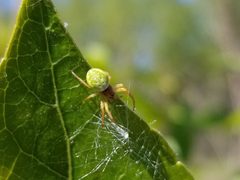
Araniella proxima is a small orb-weaver spider in the Araneidae. It is native to the Palearctic region and has been introduced to North America. The belongs to a characterized by green coloration from biliverdin pigments, which provides camouflage on leaves. It constructs small orb webs, often positioned across leaf edges.
Pronunciation
How to pronounce Araniella proxima: /ˌæɹəˈniːələ ˈprɒksɪmə/
These audio files are automatically generated. While they are not always 100% accurate, they are a good starting point.
Identification
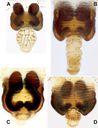
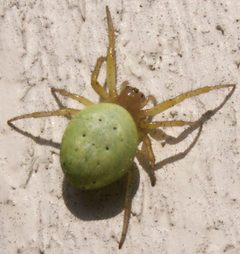
Members of the Araniella are distinguished by green coloration due to biliverdin pigments. Araniella proxima may be separated from by subtle morphological differences in genitalia structure; examination of in females and in males is typically required for definitive identification. The lacks the distinct paired black spots on the that characterize Araniella displicata.
Images
Habitat
Has been observed in woodland and heath fields. In Britain, occurs mostly in heath and heather fields rather than woodlands. Builds webs across leaf edges, typically at heights of 1–2 meters above ground.
Distribution
Native to Europe and northern Asia, with records from Russia (European part to Far East), Turkey, Iran, and Kazakhstan. Introduced to North America, where it is present but less frequently documented than the Araniella displicata. GBIF records confirm presence in Belgium.
Similar Taxa
- Araniella displicataAlso occurs in North America and shares small body size and green coloration; distinguished by three to four pairs of black spots on the and more extensively documented North American distribution.
- Araniella cucurbitinaEuropean with similar preferences and green coloration; requires genital examination for separation.
More Details
Taxonomic status
Araniella proxima was described by Kulczyński in 1885. The Araniella has received renewed taxonomic attention, with three new described from the Caucasus, Middle East and Central Asia in 2020, highlighting that the group remains incompletely known despite its wide distribution.