
Araniella displicata
(Hentz, 1847)
sixspotted orbweaver, six-spotted orbweaver
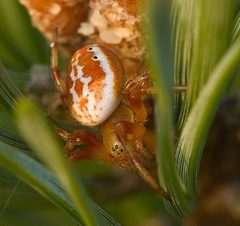
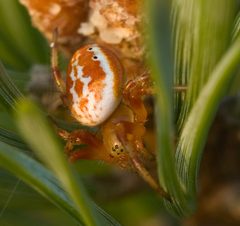
Araniella displicata, commonly known as the sixspotted orbweaver, is a small orb-weaving spider in the Araneidae. It is one of the most widely distributed arachnids in North America, with additional across Europe and Asia. are notably small—females reach only 4–8 mm in body length, males 4–6 mm—and are frequently mistaken for orb weavers due to their diminutive size. The constructs compact orb webs, often spanning single leaves, and displays considerable color variation including yellow, white, and rust red.
Pronunciation
How to pronounce Araniella displicata: /ˌærəˈniɛlə dɪsplɪˈkeɪtə/
These audio files are automatically generated. While they are not always 100% accurate, they are a good starting point.
Identification
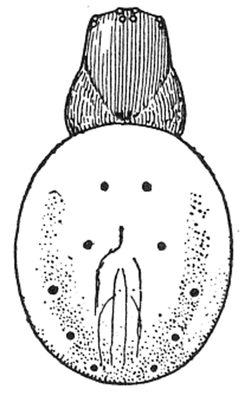
The sixspotted orbweaver is distinguished from other small orb weavers by the consistent pattern of black dots on the —three to four pairs arranged along the margins. This pattern persists across all color morphs (yellow, white, rust red). The extremely small size (under 8 mm) often leads to misidentification as a of larger orb-weaver ; examination of genitalia or the consistent abdominal pattern confirms maturity. Similar species in the Araniella, such as A. cucurbitina in Europe, require geographic context and subtle morphological differences for separation.
Images
Habitat
In North America, occupies woodland edges, forest edges, field margins, and gardens—typically in trees and shrubs. Webs are built on larger leaves, with the leaf sometimes manipulated to enhance prey capture. In Britain and northern Europe, occurs primarily in heath and heather fields rather than woodlands.
Distribution
North America (virtually entire continent including parts of Alaska), Europe (northern Europe, Britain—uncommon to rare), Russia (Europe to Far East), Kazakhstan, China, Korea, and Japan.
Seasonality
Overwinters as subadults; reaches adulthood in late May or early June in temperate regions (earlier in southern climates). Mating occurs shortly after maturity. Females produce sacs through summer. present from late spring to nearly end of summer; juveniles appear thereafter.
Diet
Small insects; beetles, plant bugs, and flies are favorable prey. Webs positioned across leaf edges intercept insects that skitter over foliage surfaces.
Life Cycle
Overwinters as subadult. sacs contain approximately 80 eggs on average, covered in loose, fluffy yellowish silk. Sacs deposited in curled leaves that serve as maternal retreats on web periphery.
Behavior
Constructs small orb webs (3–4 inches diameter) positioned 4–6 feet above ground, often horizontally oriented across single large leaves. Spider occupies hub, hanging beneath horizontal webs or -down in vertical ones. Female remains near sac after deposition.
Ecological Role
of small flying and foliage-dwelling insects; contributes to and shrub-layer . Serves as prey for larger arthropods and possibly small vertebrates.
Human Relevance
Occasionally encountered in gardens and yards; harmless to humans despite being venomous (not dangerously so). Frequently mistaken for spiders due to small size. Subject of citizen science observation and photographic documentation.
Similar Taxa
- Other Araniella species (e.g., A. cucurbitina)Share and general appearance; require geographic context and detailed morphological examination for separation
- Juvenile Araneus and other large orb-weaver generaSimilar small size leads to confusion; A. displicata distinguished by consistent abdominal pattern and mature genitalia
Misconceptions
Commonly mistaken for a spider due to its small size; the name 'sixspotted' refers to abdominal markings but dot number can vary (three to four pairs).
More Details
Habitat divergence
Notable geographic difference in preference: woodland-associated in North America versus heathland-associated in Britain.
Web architecture
Unlike most orb weavers that build large webs relative to body size, A. displicata constructs notably compact webs, an to leaf-edge positioning.