
Opilioacarida
Order Guides
1- Opilioacaroidea(mite harvestmen)
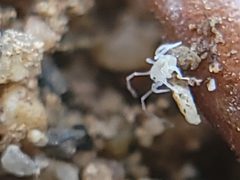
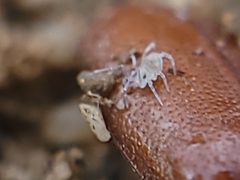
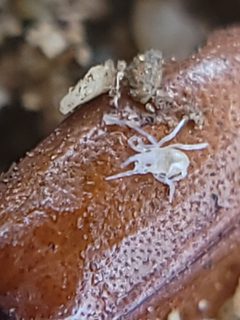
Opilioacarida is a small order of mites containing a single , Opilioacaridae, with approximately 13 and 53 valid . These mites are among the largest of their kind (1.5–2.5 mm) and are considered primitive due to retained ancestral traits including six pairs of and abdominal segmentation. Molecular places them within Parasitiformes, though historically they were treated as distinct from both Acariformes and Parasitiformes. The group has a worldwide distribution with notable diversity in the Americas.
Pronunciation
How to pronounce Opilioacarida: /oˌpɪ.ljoʊ.əˈkær.ɪ.də/
These audio files are automatically generated. While they are not always 100% accurate, they are a good starting point.
Identification
Distinguished from other mites by the combination of large body size (1.5–2.5 mm), retention of six pairs of , and visible abdominal segmentation. Most mites have a , unsegmented body and fewer eyes. Within Parasitiformes, Opilioacarida lack the highly reduced body plan of Holothyrida and the specialized feeding structures of Ixodida (ticks). The presence of waxy microplates on the , visible under scanning electron microscopy, provides -level diagnostic characters. An updated key to is available for identification to genus.
Images
Appearance
Relatively large mites measuring 1.5–2.5 mm in length. Retain six pairs of , a primitive trait among mites. Body shows distinct abdominal segmentation, unlike the idiosoma of most other mites. covered by waxy microplates. Some exhibit three pairs of eyes rather than six. Palps bear d-type setae whose numbers may increase with growth. Legs II–IV lack articulated acrotarsus in some . Haller's organ pit contains three at the base of a long sensilla.
Habitat
Occupies semi-arid and tropical environments, including leaf litter, under rocks, and caves. In Mexico, found from sea-level dunes to high temperate and cloud forests above 2,000 m elevation, spanning semideserts to tropical forests. Brazilian occur in ferruginous geosystems and caves. Cave-dwelling species documented in Brazil, Belize, and elsewhere. Mesophyll forests and pine-oak forests also support .
Distribution
Worldwide distribution with greatest documented diversity in the Americas. Recorded from Mexico (Querétaro, Veracruz, coastal plains to altiplano), Belize (Maya Mountains), Brazil (Amazonia, Bahia, Minas Gerais), Argentina, Venezuela, Caribbean region (Cuba, Puerto Rico), United States (Texas), Madagascar, Southern Europe (Italy, Greece including Kassos, Karpathos, Rhodes; Andorra in Pyrenees), Thailand, Angola, India, and Algeria. Two fossil specimens known: one in Baltic amber (Eocene) and one in Burmese amber (Late Cretaceous, ~99 million years), tentatively assigned to Opilioacarus.
Diet
Includes carcasses, fungal spores, and pollen. appear to facilitate feeding by in at least one .
Life Cycle
Post-embryonic development includes and tritonymph stages. Larvae are non-feeding and quickly to protonymphs. undergo postimaginal molting, with documented increases in setal lengths (8.1–16.6%) and qualitative growth in setal numbers. Adult growth challenges the assumption that adult arachnids cease growth after maturation. Females deposit one at a time, with eggs coated before deposition. Females guard both eggs and larvae.
Behavior
Females guard and larvae. Pre-mating documented, though actual mating has not been directly observed. appear to facilitate feeding by , suggesting parental care or cooperative feeding behavior.
Human Relevance
Of interest to acarologists as a primitive mite lineage retaining ancestral arachnid characteristics. Subject of advanced microscopy studies due to well-preserved soft tissue structure suitable for low-temperature scanning electron microscopy. No documented economic or medical importance.
Similar Taxa
- HolothyridaAnother primitive order of Parasitiformes, but Holothyrida have a more reduced body plan and lack the six pairs of and distinct abdominal segmentation of Opilioacarida.
- Ixodida (ticks)Also Parasitiformes, but ticks are obligate blood-feeding with highly modified mouthparts and lack the segmented and multiple pairs of Opilioacarida.
- AcariformesThe other major mite lineage; Acariformes lack the arrangement and abdominal segmentation of Opilioacarida and show fundamentally different morphological organization.
More Details
Taxonomic history
First described was Opilioacarus segmentatus from Algeria (1902), followed by Eucarus italicus from Sicily and Eucarus arabicus from Aden (1904). Historically treated as separate from both Acariformes and Parasitiformes, but molecular now places Opilioacarida within Parasitiformes.
Research significance
The soft makes Opilioacarida excellent subjects for low-temperature scanning electron microscopy, contributing to studies of microplates that allow -level 'fingerprinting'. Recent taxonomic work in the Americas has substantially expanded known diversity.
Conservation status
Many are known from single localities or limited collections, suggesting potential vulnerability, though no formal assessments exist.
Sources and further reading
- BugGuide
- Wikipedia
- GBIF taxonomy match
- iNaturalist taxon
- NCBI Taxonomy
- Catalogue of Life
- Opilioacaridae Archives - Entomology Today
- Of Mites and Men: A Visit to the USDA Electron & Confocal Microscopy Unit
- Catalog of the Opilioacarida (Acari: Parasitiformes)
- Adult Growth in Opilioacaridae with 1904 (Acari: Parasitiformes: Opilioacarida)
- The family Opilioacaridae (Parasitiformes: Opilioacarida) in Mexico, description of two new species, new records, and geographical distribution
- A new species of Opilioacaridae (Parasitiformes: Opilioacarida) from Belize with some observations on life history and behavior
- Taxonomic Catalog of the Brazilian Fauna: The Brazilian acarofauna (Arachnida: Holothyrida, Ixodida, Mesostigmata, Opilioacarida, Sarcoptiformes, and Trombidiformes)
- The family Opilioacaridae (Parasitiformes: Opilioacarida) in Mexico, description of two new species and notes on biology and geographical distribution
- A new six-eyed genus and species of Opilioacarida (Acari: Parasitiformes) for Southern Europe with an overview of the group and updated genus key
- Figure 12 from: Bernardi LFO, Zampaulo RA, Oliveira MPA (2020) A new species of Neocarus (Opilioacaridae) from a Brazilian ferruginous geosystem and notes on natural history. Subterranean Biology 36: 11-33. https://doi.org/10.3897/subtbiol.36.54034