
Opilioacaridae
With, 1902
Opilioacarid mites, Primitive mites
Genus Guides
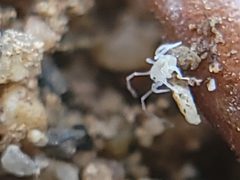
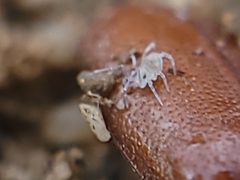
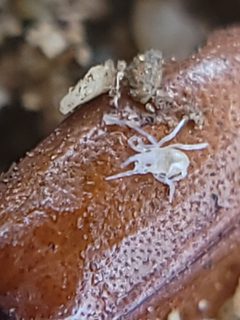
1Opilioacaridae is the sole in the order Opilioacarida, comprising approximately 13 of rare, relatively large mites (1.5–2.5 mm). These mites are considered primitive due to retention of six pairs of and abdominal segmentation, traits lost in other mite lineages. Historically treated as distinct from both Acariformes and Parasitiformes, molecular now places them within Parasitiformes. The family exhibits a disjunct global distribution with in semi-arid and tropical regions, including caves, leaf-litter, and rock .
Pronunciation
How to pronounce Opilioacaridae: /oʊˌpɪlioʊəˈkærɪdiː/
These audio files are automatically generated. While they are not always 100% accurate, they are a good starting point.
Identification
Opilioacaridae can be distinguished from other mite by the combination of six pairs of (most mites have fewer or none), retention of abdominal segmentation, and relatively large body size (1.5–2.5 mm). The palpal chaetotaxy, particularly the number and shape of d-type setae, is critical for -level identification: Neocarus typically has 4–9 foliate d setae with a stout rounded lobe, while Caribeacarus has 8–12 foliate d setae with a fine pointed lobe. occurs in setal on the shield, with males showing differences in the prominent triangular region.
Images
Habitat
Semi-arid and tropical environments including leaf-litter, under rocks, and caves. In Mexico, documented across diverse from sea-level coastal dunes to high-elevation cloud forests (>2,000 m), encompassing mesophyll forests, pine-oak forests, semideserts, and temperate forests. Brazilian records include ferruginous geosystems (epigean and hypogean) and limestone cave systems.
Distribution
Disjunct global distribution including: North America (Mexico, southern United States), Central America (Belize), South America (Brazil, Amazonia), Caribbean, Madagascar, India, and Greece. In Mexico, occurs from coastal plains to altiplano; in Brazil, documented from Minas Gerais, Bahia, and other karst regions. Fossil specimens known from Baltic amber (Eocene) and Burmese amber (Late Cretaceous, ~99 mya).
Diet
Known to include carcasses, fungal spores, and pollen. Gut content analysis has been employed to confirm dietary items. Specific feeding mechanisms and breadth remain poorly documented for most .
Life Cycle
Post-embryonic development includes tritonymph stage. Larvae are non-feeding and rapidly to . exhibit postimaginal molting with continued growth after sexual maturity, including increases in setal length (8.1–16.6% observed) and qualitative changes in setal number. Adults appear to facilitate feeding by protonymphs.
Behavior
Females deposit single nearly always one at a time; eggs are coated before deposition. Females guard both eggs and larvae. Pre-mating has been documented though actual mating has not been directly observed. continue to grow and after reaching sexual maturity, a rare trait among arachnids associated with appendage and setal addition.
Human Relevance
Of interest to acarologists as a primitive mite lineage preserving ancestral arachnid traits. Some inhabit caves, making them relevant for subterranean biodiversity and conservation assessments. No documented economic importance as pests or beneficial organisms.
Similar Taxa
- Other Parasitiformes (e.g., Ixodidae, Mesostigmata)Opilioacaridae differ in retaining six pairs of and abdominal segmentation, versus reduced or absent eyes and unsegmented in other groups. They also exhibit postimaginal molting, rare in Parasitiformes.
- AcariformesOpilioacaridae were historically separated from Acariformes based on morphological and developmental differences; molecular data now places them in Parasitiformes, but they retain distinct and segmentation patterns.
Sources and further reading
- BugGuide
- Wikipedia
- GBIF taxonomy match
- iNaturalist taxon
- Catalogue of Life
- Opilioacaridae Archives - Entomology Today
- Of Mites and Men: A Visit to the USDA Electron & Confocal Microscopy Unit
- Adult Growth in Opilioacaridae with 1904 (Acari: Parasitiformes: Opilioacarida)
- The family Opilioacaridae (Parasitiformes: Opilioacarida) in Mexico, description of two new species, new records, and geographical distribution
- A new species of Opilioacaridae (Parasitiformes: Opilioacarida) from Belize with some observations on life history and behavior
- A new species of Neocarus (Opilioacaridae) from a Brazilian ferruginous geosystem and notes on natural history
- Two new sympatric species of cave-dwelling Neocarus (Acari: Opilioacaridae) from the Bambuí limestone group, Brazil
- A new species of cave dwelling Neocarus (Acari: Opilioacaridae) from Bahia state, Brazil, with remarks on taxonomic characters
- The family Opilioacaridae (Parasitiformes: Opilioacarida) in Mexico, description of two new species and notes on biology and geographical distribution
- Figure 13 from: Bernardi LFO, Zampaulo RA, Oliveira MPA (2020) A new species of Neocarus (Opilioacaridae) from a Brazilian ferruginous geosystem and notes on natural history. Subterranean Biology 36: 11-33. https://doi.org/10.3897/subtbiol.36.54034
- Figure 1 from: Bernardi LFO, Zampaulo RA, Oliveira MPA (2020) A new species of Neocarus (Opilioacaridae) from a Brazilian ferruginous geosystem and notes on natural history. Subterranean Biology 36: 11-33. https://doi.org/10.3897/subtbiol.36.54034
- Figure 11 from: Bernardi LFO, Zampaulo RA, Oliveira MPA (2020) A new species of Neocarus (Opilioacaridae) from a Brazilian ferruginous geosystem and notes on natural history. Subterranean Biology 36: 11-33. https://doi.org/10.3897/subtbiol.36.54034
- Figure 3 from: Bernardi LFO, Borges-Filho EL (2018) Neocarus spelaion sp. n. (Parasitiformes, Opilioacaridae), a new species of cave dwelling Neocarus from Minas Gerais state, Brazil. Subterranean Biology 27: 1-16. https://doi.org/10.3897/subtbiol.27.25777
- Figure 1 from: Bernardi LFO, Borges-Filho EL (2018) Neocarus spelaion sp. n. (Parasitiformes, Opilioacaridae), a new species of cave dwelling Neocarus from Minas Gerais state, Brazil. Subterranean Biology 27: 1-16. https://doi.org/10.3897/subtbiol.27.25777
- Figure 9 from: Bernardi LFO, Zampaulo RA, Oliveira MPA (2020) A new species of Neocarus (Opilioacaridae) from a Brazilian ferruginous geosystem and notes on natural history. Subterranean Biology 36: 11-33. https://doi.org/10.3897/subtbiol.36.54034
- Figure 3 from: Bernardi LFO, Zampaulo RA, Oliveira MPA (2020) A new species of Neocarus (Opilioacaridae) from a Brazilian ferruginous geosystem and notes on natural history. Subterranean Biology 36: 11-33. https://doi.org/10.3897/subtbiol.36.54034
- Figure 5 from: Bernardi LFO, Zampaulo RA, Oliveira MPA (2020) A new species of Neocarus (Opilioacaridae) from a Brazilian ferruginous geosystem and notes on natural history. Subterranean Biology 36: 11-33. https://doi.org/10.3897/subtbiol.36.54034