
Trachytidae
Genus Guides
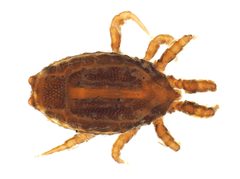
2Trachytidae is a of mites in the order Mesostigmata, classified within the suborder Uropodina. The family comprises three recognized : Trachytes, Uroseius, and Polyaspinus. Members are primarily soil-dwelling or associated with decaying organic matter, with some documented from animal remains. The genus Uroseius has been studied for its morphological characteristics across developmental instars, including observations of cuticular organs and idiosomal setation patterns.
Pronunciation
How to pronounce Trachytidae: /trəˈkaɪtɪdiː/
These audio files are automatically generated. While they are not always 100% accurate, they are a good starting point.
Identification
Trachytidae can be distinguished from other Uropodina by morphological features of the idiosoma and leg chaetotaxy. Within the family, are separable by characteristics of the deutonymph and female stages; a key to world of Uroseius exists based on these instars. The family shares general Uropodina traits including a dorsoventrally flattened body form and reduced stigmata positioned between III and IV.
Images
Habitat
Soil and decaying organic matter; at least one of Uroseius has been documented from animal remains in northern Spain.
Distribution
Documented from the Iberian Peninsula (Spain), with distribution records also indicated for Norway and Sweden. The likely has broader distribution given its soil-dwelling , but specific records remain limited.
Life Cycle
Development includes larval and pronymphal instars with complete chaetome described for these stages in Uroseius. Deutonymph and female instars are used for -level identification.
Behavior
Ecological Role
Associated with decomposition processes, particularly of animal remains; potential forensic .
Similar Taxa
- UropodidaeBoth belong to Uropodina and share dorsoventrally flattened body ; distinguished by specific chaetotaxy patterns and idiosomal setation.
- LaelapidaeBoth are Mesostigmata ; Laelapidae are more commonly parasitic or commensal with vertebrates and arthropods, while Trachytidae are primarily free-living in soil and decaying matter.
More Details
Taxonomic History
The was established with Trachytes as the type . In 1960, Daniel G. Maiello noted an unnamed family related to Trachytidae while researching Laelaps multispinosus.
Morphological Research
Recent work on Uroseius has attempted to standardize idiosomal setal notation using the Gamasina system, facilitating comparisons with other Mesostigmata.
Sources and further reading
- BugGuide
- Wikipedia
- GBIF taxonomy match
- iNaturalist taxon
- NCBI Taxonomy
- Catalogue of Life
- D1SCOURELLA AEGYPTICUS, A NEW UROPODIOD MITE, WITH NOTES ON ITS BIOLOGY (ACARI: GAMASIDA: TRACHYTIDAE).
- <p class="Body">The genus Uroseius Berlese (Acari: Mesostigmata: Uropodina: Trachytidae) in the Iberian Peninsula with description of a new species associated with animal remains