
Uropodina
Infraorder Guides
1- Uropodoidea(tortoise mites)
Uropodina is an infraorder of mites in the order Mesostigmata, characterized by morphologically variable forms with sternal and shields, short legs with reduced setae, and stigmata positioned between the second and third leg pairs. Most inhabit soil, forest litter, and decaying organic matter, where they function primarily as of small . Many species exhibit during the deutonymph stage, attaching to insects and other arthropods for using a secreted elastic . is predominantly sexual, though occurs in some species with males rare or absent.
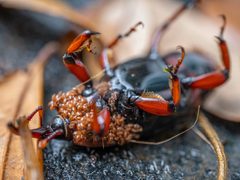
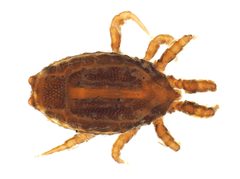
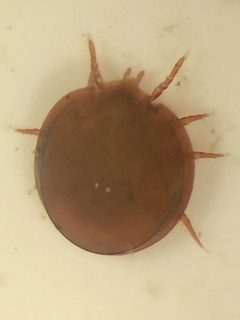
Pronunciation
How to pronounce Uropodina: /ˌjʊə.rəˈpɒd.ɪ.nə/
These audio files are automatically generated. While they are not always 100% accurate, they are a good starting point.
Identification
Distinguished from other Mesostigmata by the combination of: sternal- shields, hypostomal setae in a row, enlarged first covering the tritosternum base, and stigmata between leg pairs II-III. Phoretic deutonymphs possess an elastic for attachment. remains unresolved; identification to often requires examination of multiple life stages.
Images
Appearance
Sternal and shields usually . Hypostomal setae arranged in a single row. Legs relatively short with reduced setae. of the first leg pair greatly enlarged, partially or entirely covering the base of the tritosternum. Stigmata situated between the second and third leg pairs. Morphologically variable across the group; many only known from certain life stages.
Habitat
Soil, forest litter, moss, lichen, under rocks, animal nests, , and carrion. Associated with dead wood, particularly deciduous trees (beech, oak, linden, hornbeam) and some conifers (pine, spruce). Some specialized to nests, nests, or army ant colonies. Abundance reaches 5,000 individuals/m² in meadow soils and 2,000 individuals/m² in agricultural soils.
Distribution
Global distribution with high reported ; many known from single continents. show hemispheric patterns: Trachytes, Cilliba, and Urodiaspis restricted to northern hemisphere; Rotundabaloghia, Castriidinychus, Platysetosus, Acroseius, and Capricornelia restricted to southern hemisphere. Knowledge limited outside Europe; true distribution patterns require further investigation.
Diet
Most are of small such as . Some species may be fungivorous or herbivorous. species associated with army ant pupae; feeding on suggested but direct evidence questioned.
Host Associations
- bees (Apis, Bombus, Euglossa, Melipona) - Multiple (Trachytidae, Trematuridae, Uroactiniidae, Urodinychidae, Uropodidae); believed harmless to
- army ants (Eciton burchellii and related species) - Macrodinychus infect pupae; low rates observed
- burying beetles (Nicrophorus spp.) - Males carry greater mite burden than females; - and sex-specific patterns
- insects and other arthropods - General phoretic during deutonymph stage
Life Cycle
Development includes deutonymph stage specialized for ; secretes elastic to attach to animal for transport. Some exhibit (Cilliba erlangensis, C. rafalskii); most are bisexual and probably arrhenotokous. Many species only known from partial information.
Behavior
Phoretic deutonymphs actively seek and attach to arthropods for . show behavioral interactions with host ants including by . Infected army ant pupae may be left behind during colony as potential counter-defense. Some species capable of with extremely rare or absent males.
Ecological Role
of soil and small . Contributors to soil dynamics and decomposition processes in forest litter and dead wood. Phoretic facilitate and potentially across . species may regulate ; potential biocontrol applications suggested but unverified.
Human Relevance
of earthworm cultures and stored food by a few . Potential biocontrol agents for pest ants suggested based on lifestyle. Subject of taxonomic and ecological research due to high diversity and unresolved .
Similar Taxa
- other MesostigmataUropodina distinguished by sternal- shields, hypostomal setae in row, enlarged first , and stigmata position between legs II-III
More Details
Taxonomic uncertainty
Uropodina remains unresolved; morphological variability and incomplete knowledge for many complicate classification.
Endemism debate
High reported may be partially artifactual due to limited sampling outside Europe and taxonomic inflation; true biogeographic patterns require expanded survey effort.
Sources and further reading
- BugGuide
- Wikipedia
- iNaturalist taxon
- NCBI Taxonomy
- Catalogue of Life
- Endemism of Uropodina Mites: Spurious or Real?
- Uropodina species from Vietnam (Acari: Mesostigmata)
- Peer Review #1 of "Infection of army ant pupae by two new parasitoid mites (Mesostigmata: Uropodina) (v0.1)"
- Uropodina mites with unusual chelicerae from Thailand (Acari: Mesostigmata)
- Peer Review #3 of "Infection of army ant pupae by two new parasitoid mites (Mesostigmata: Uropodina) (v0.1)"
- Peer Review #2 of "Infection of army ant pupae by two new parasitoid mites (Mesostigmata: Uropodina) (v0.1)"
- Review of the genus Cilliba von Heyden (Acari: Uropodina: Cillibidae)
- Males have a greater mite burden than females, and size does not matter: species- and sex-specific infestation patterns of mites (Uropodina) on burying beetles (Nicrophorus spp.).