
Dermanyssina
Genus Guides
6
Pronunciation
How to pronounce Dermanyssina: /dɛr.maˈnɪs.sɪ.nə/
These audio files are automatically generated. While they are not always 100% accurate, they are a good starting point.
Identification
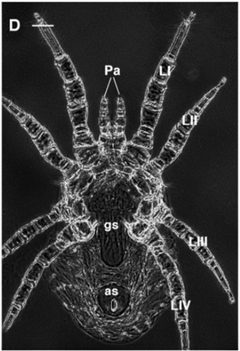
Dermanyssina is distinguished from other Mesostigmata by gnathosomatic attributes associated with parasitic or phoretic habits. Specific diagnostic features vary among constituent and .
Images
Habitat
Associated with organisms including carabid beetles and labidurid ; some require hosts for survival.
Distribution
Eurasia (based on records of constituent such as Anystipalpus); broader distribution likely given the subordinal rank.
Host Associations
- carabid beetles (Coleoptera: Carabidae) - females found under
- labidurid earwigs (Labiduridae) - extraordinary phoretic association; females found under tegmina
Life Cycle
plays a significant role in . In some , only females are known, suggesting a potential role for adult female morphs in or . Laboratory rearing of some requires regular replacement due to host mortality.
Behavior
Phoretic is well-documented: females attach to or tegmina for transport. Feeding, mating, transmission, and interactions with other mites have not been directly observed in some studied ; indirect observations only.
Similar Taxa
- Ascoidea (superfamily)Anystipalpus was historically of uncertain placement between Ascoidea and Dermanyssoidea; resolved to Dermanyssina based on morphological reexamination
More Details
Taxonomic Uncertainty
The -level placement of some Dermanyssina remains under reconsideration. Genera Anystipalpus, Antennoseius, and Vitzthumia form a closely related complex with unresolved higher-level relationships.
Research Limitations
Direct observation of feeding, mating, and transmission remains difficult for some ; laboratory mortality complicates biological study.