
Ornithodoros turicata
Dugès, 1876
relapsing fever tick
Ornithodoros turicata is a ( Argasidae) found in the midwestern and southwestern United States. It is the primary of Borrelia turicatae, the spirochete agent of -borne in humans. The tick has been documented feeding on at least 27 vertebrate across mammals, birds, reptiles, and amphibians. It exhibits ( production without a bloodmeal) and of spirochetes, enabling maintenance across .
Pronunciation
How to pronounce Ornithodoros turicata: /ɔrˌnɪθəˈdɔroʊs ˌtʊrɪˈkɑtə/
These audio files are automatically generated. While they are not always 100% accurate, they are a good starting point.
Identification
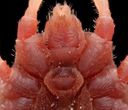
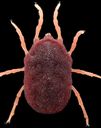
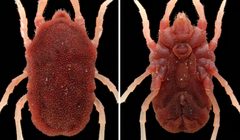
Soft ticks of the Argasidae lack the hard present in ixodid (hard) ticks. Ornithodoros turicata can be distinguished from hard ticks by its leathery, wrinkled and the absence of visible mouthparts from above. As an , it feeds rapidly (minutes to hours) rather than remaining attached for days. Specific morphological characters distinguishing O. turicata from require microscopic examination of capitular and spiracular structures.
Images
Habitat
Occupies cavity environments including burrows, dens, caves, and sheltered rocky crevices. Associated with nesting sites and resting places rather than vegetation. Success in cavity microhabitats reflects to sheltered, humid refugia where hosts regularly return.
Distribution
Midwestern and southwestern United States; records from Texas, California, and other states within this range. GBIF records indicate presence in Middle America and North America.
Diet
Obligate blood-feeder on vertebrate . Bloodmeal metabarcoding has identified 27 host : 17 mammals, 5 birds, 1 reptile, and 4 amphibians. Documented hosts include desert tortoise (Gopherus agassizi), wild pig (Sus scrofa), chicken, goat, and domestic swine. Multiple host species may be detected within individual ticks, indicating successive feedings on different hosts.
Host Associations
- Gopherus agassizi - desert tortoise in California
- Sus scrofa - wild pig; first documented off- detection
- Gallus gallus - chicken
- Capra aegagrus hircus - goat
- Sus scrofa domesticus - domestic swine
Life Cycle
→ larva → nymph (multiple instars, typically 3–5) → . Complete development from egg to egg-laying female has been accomplished in laboratory conditions. Females exhibit , producing eggs without an additional bloodmeal. of Borrelia turicatae to progeny has been demonstrated.
Behavior
Rapid feeding typical of argasid ticks: bloodmeals are completed in minutes to hours rather than the extended attachment of hard ticks. Multiple nymphal instars occur between larval and stages. Can survive extended periods between bloodmeals. allows production without vertebrate contact.
Ecological Role
of Borrelia turicatae, maintaining and transmitting spirochetes among vertebrate . enables the to serve as a natural , perpetuating independently of availability. Bloodmeal analysis indicates involvement in connecting circulation across diverse wildlife, domestic animal, and human interfaces.
Human Relevance
Primary of -borne caused by Borrelia turicatae in humans. Laboratory demonstration of vector competence for Leptospira pomona, agent of canine jaundice. Potential concern for virus transmission should it be introduced to the United States, given documented feeding on wild pigs.
Similar Taxa
- Ornithodoros hermsiAlso a North American of spirochetes; distinguished by geographic distribution and specific morphological characters of the capitulum and spiracular plates
- Ornithodoros parkeriOverlapping distribution and similar use in burrows and caves; requires microscopic examination for definitive identification
- Ixodid ticks (hard ticks)Readily distinguished by presence of hard , extended feeding duration (days), and visible mouthparts from view; O. turicata lacks scutum and feeds rapidly
Sources and further reading
- BugGuide
- Wikipedia
- GBIF taxonomy match
- iNaturalist taxon
- NCBI Taxonomy
- Catalogue of Life
- Ecology ofOrnithodoros turicata: Success in the cavity environment
- Life Cycle of Ornithodoros Turicata Americanus (Acari: Argasidae) in the Laboratory1
- The Desert Tortoise, Gopherus agassizi, a Host for the Tick Ornithodoros turicata in California
- Vertical transmission of Borrelia turicatae (Spirochaetales: Borreliaceae ) by autogenously reproducing Ornithodoros turicata (Ixodida: Argasidae) female naturally infected with the spirochetes
- Identification of Host Bloodmeal Source in Ornithodoros turicata Dugès (Ixodida: Argasidae) Using DNA-Based and Stable Isotope-Based Techniques
- Bloodmeal metabarcoding of the argasid tick ( Ornithodoros turicata Dugès) reveals extensive vector-host associations
- Range Modeling and Surveillance of Ornithodoros turicata Ticks: Implications for Detecting African Swine Fever Virus in the United States.