
Acalitus
Keifer, 1965
Species Guides
4- Acalitus brevitarsus(Alder erineum mite)
- Acalitus ferrugineum(beech erineum mite)
- Acalitus phloeocoptes(Apricot bud gall mite)
- Acalitus ruelliae
Acalitus is a of microscopic eriophyoid mites in the Eriophyidae. within this genus are plant that induce gall formation on various plants. Several species are significant agricultural pests, including Acalitus essigi and Acalitus vaccinii, which affect berry crops, and Acalitus phloeocoptes, which damages stone fruit trees. The genus exhibits narrow host specificity, with individual species typically restricted to particular plant genera or families.
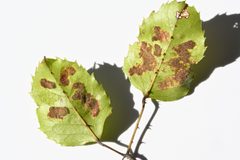
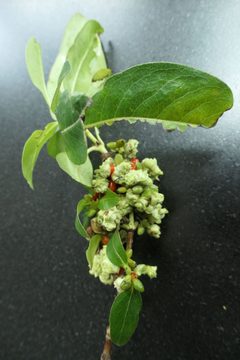
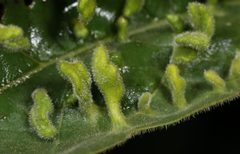
Pronunciation
How to pronounce Acalitus: /əˈkælɪtəs/
These audio files are automatically generated. While they are not always 100% accurate, they are a good starting point.
Identification
Identification to requires microscopic examination of slide-mounted specimens, preferably using phase contrast or differential interference contrast microscopy. Critical characters include: structure of the (simple, rayed, or divided); presence and arrangement of shield setae (vi, ve, sci, sce); details of the coxal setation; and genital coverflap ornamentation in females. For some species, scanning electron microscopy reveals additional diagnostic features such as microtubercle patterns. using COI and 18S rRNA sequences provides supplementary identification support, with congeneric species showing 16–28% mitochondrial divergence.
Images
Appearance
Microscopic mites with the characteristic (worm-like) body plan typical of Eriophyoidea. possess two pairs of legs located anteriorly; legs are reduced in segmentation compared to other mites. Body elongate and cylindrical, lacking distinct separation between prosoma and opisthosoma. with fine microtubercles or annulations. Mouthparts are cheliceral stylets adapted for piercing plant . Specific morphological characters vary among and include details of shield ornamentation, structure, and setal arrangements.
Habitat
Phytophagous mites inhabiting living plant tissues. Specific microhabitats vary by and include: vegetative and reproductive buds, leaf surfaces (especially lower ), fruit drupelets, and shoots. Some species induce enclosed galls within bud tissues; others form open erinea (felt-like patches of plant hairs) on leaf surfaces. Agricultural occur in commercial orchards and plantations of crops.
Distribution
distribution with documented across North America, South America, Europe, Asia, Africa, and Australia. Specific range varies by species: A. essigi occurs in North America, Mexico, Australia, and Brazil; A. vaccinii is native to North America with introduced in South Africa; A. phloeocoptes is distributed across Europe, Asia, and North America; A. simplex is recorded from the Caribbean, South America, and Hawaii.
Seasonality
Activity patterns vary by and climate. Acalitus phloeocoptes shows four annually with as females in galls; accumulation of 68–90 DD (base temperature 5.8–6.2°C) predicts 50% spring . In temperate regions, gall mites are active during the growing season when plants produce new growth; dormancy occurs in winter within protected plant tissues.
Diet
Obligate phytophagous feeding on living plant contents. Feeding occurs via puncture of epidermal or parenchymal cells using cheliceral stylets, followed by extraction of . associations are typically narrow: A. essigi and A. orthomerus on Rubus (blackberry); A. vaccinii on Vaccinium (blueberry); A. phloeocoptes on Prunus (plum, apricot, peach, almond); A. simplex on Ruellia; A. viguierae on Viguiera.
Host Associations
- Rubus spp. - A. essigi, A. orthomerus; causes redberry and inhibited fruit ripening
- Vaccinium spp. - A. vaccinii; blueberry bud mite damaging cultivated blueberries
- Prunus spp. - A. phloeocoptes; includes plum, apricot, peach, almond, myrobalan plum, blackthorn
- Ruellia spp. - A. simplex; causes erinea on ornamental R. simplex
- Viguiera dentata - A. viguierae; causes erineum on lower leaf surface
- Sphagneticola trilobata - A. comptus
- Gossypium spp. - A. gossypii; cotton leaf blister mite
Life Cycle
with development through , larva, nymph (two instars: and deutonymph), and stages. All active instars feed on plant tissues. In A. phloeocoptes, occurs as adult females within galls; spring is temperature-dependent. time varies with temperature and plant ; A. phloeocoptes completes four generations annually in studied . occurs primarily through or wind-borne aerial transport during periods of population pressure.
Behavior
Sedentary lifestyle with limited mobility; individuals typically remain within single galls or on localized plant structures. Coexistence of multiple observed: A. essigi and A. orthomerus frequently co-occur in blackberry buds and drupelets, complicating identification and attribution. Gall induction involves manipulation of plant growth regulators: elevated cytokinin and auxin promote rapid bud proliferation, while abscisic acid controls gall maturation and reduced gibberellic acid triggers lignification. Feeding triggers characteristic host including gall formation, erineum production, or fruit developmental disorders.
Ecological Role
Primary consumers functioning as specialized plant . cause direct economic damage to agricultural crops through reduced yield and fruit quality. A. essigi has been evaluated as a prospective agent for Rubus in Australia, though limited natural capacity may necessitate artificial redistribution. No documented roles as prey species or in nutrient cycling.
Human Relevance
Significant agricultural pests requiring integrated management. Control strategies include: pruning and removal of infested plant material; application of or sulfur sprays during dormancy; and targeted acaricide applications (abamectin, propargite, tetradifon) timed using models. A. essigi presents potential conflict between of weeds and protection of commercial berry crops. Accurate identification is essential for effective management, particularly where multiple Acalitus species co-occur.
Similar Taxa
- EriophyesCongeneric eriophyoid gall mites; distinguished by structure, shield setation patterns, and associations
- AculusRelated eriophyoid including vagrant leaf vagrants; differs in microtubercle arrangement and typically does not induce enclosed galls
- DiptacusDiptilomiopid mites co-occurring on Rubus; distinguished by -level characters including palp structure and leg chaetotaxy
More Details
Taxonomic History
Acalitus was established by Keifer in 1965. Some were originally described in Eriophyes and later transferred; for example, A. essigi was described as Eriophyes essigi by Hassan in 1928.
Gall Development Mechanism
Research on A. phloeocoptes reveals phytohormonal manipulation underlying gall formation: cytokinin and auxin accumulation drives rapid bud proliferation, abscisic acid regulates gall maturity, and gibberellic acid reduction triggers lignification. Starch extension in bud occurs early in , followed by cytoplasmic deterioration in later stages.
Identification Challenges
Morphological similarity between A. essigi and A. orthomerus has historically confounded identification and attribution. Both coexist in blackberry tissues and were previously conflated in reports of redberry disease causation. Accurate discrimination requires careful microscopic examination or molecular methods.
Sources and further reading
- BugGuide
- Wikipedia
- GBIF taxonomy match
- iNaturalist taxon
- NCBI Taxonomy
- Acalitus gossypii . [Distribution map].
- Acalitus phloeocoptes . [Distribution map].
- Population fluctuation of Acalitus essigi and Acalitus orthomerus (Acari: Eriophyidae) associated with inhibited ripening of blackberry (Rubus spp.)
- A new species of Acalitus (Acari: Eriophyoidea) on Viguiera dentata and the first record of Acalitus comptus Flechtmann on Sphagneticola trilobata from Mexico
- Sarocladium terricola1 Associated with Acalitus orthomera on Blackberry Fruits
- Revised description of the blueberry bud mite, Acalitus vaccinii (Acari: Trombidiformes: Eriophyidae), and a key to all Eriophyoidea on Vaccinium
- Intraplant distribution of Acalitus essigi (Acari: Eriophyoidea) on blackberries (Rubus fruticosus agg.)
- Interaction of the Causal Agent of Apricot bud gall Acalitus phloeocoptes (Nalepa) with Apricot: Implications in Infested Tissues
- First report of Acalitus simplex (Acari: Eriophyidae) in the Dominican Republic
- Redberry mite, Acalitus essigi (Hassan) (Acari: Eriophyidae), an additional biological control agent for Rubus species (blackberry) (Rosaceae) in Australia
- Evaluation of different control strategies for the management of redberry disease associated with Acalitus orthomera (Eriophyoidea: Eriophyidae) in commercial blackberry crops
- Interaction of the causal agent of apricot bud gall Acalitus phloeocoptes (Nalepa) with apricot: Implications in infested tissues
- <span style="font-family: Times New Roman;">Eriophyoid mites associated with the blackberry in Brazil—a new species in the genus Diptacus Keifer 1951 (Diptilomiopidae) and first report and supplementary description of Acalitus orthomerus (Keifer, 1951) (Eriophyidae)</span>
- Biology of Apricot Bud Gall Mite, Acalitus phloeocoptes Determining the Emergence Time of the First Generation Using the Degree Day Model and Its Control
- Scrutinizing Acalitus simplex Flechtmann et Etienne (Eriophyidae): an eriophyoid mite associated with Ruellia spp. (Acanthaceae)