
Achipteriidae
Thor, 1929
Achipteriidae is a of oribatid mites (Acari: Oribatida) comprising approximately 9 and at least 80 described . Members of this family are primarily arboreal, with documented species inhabiting lichens on coniferous trees in temperate montane forests. The family exhibits morphological diversity in lamellar structure, pteromorphic projections, and notogastral setation patterns. Some species achieve high densities in arboreal microhabitats, suggesting significant ecological importance in forest canopy .
Pronunciation
How to pronounce Achipteriidae: //ˌækɪpˈtɛri.aɪdi//
These audio files are automatically generated. While they are not always 100% accurate, they are a good starting point.
Identification
Achipteriidae can be distinguished from other oribatid by the combination of: long and wide typically in the medial part; long pteromorphic projections; and 10 pairs of notogastral setae with variable length patterns (notably longer c2 and la in some ). The number and form of notogastral saccules or porose areas varies among species (ranging from one pair to four pairs). Leg includes specific setal proportions: genu IV longer than tibia IV; anteroventral present on genua I and II in some species; and smooth leg claws. Juveniles are characteristically stocky with minute or short, smooth prodorsal setae and thick, barbed gastronotal setae (except c2, c3, and h3 in larvae, which are minute).
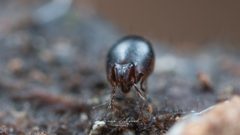
Images
Habitat
Arboreal , particularly foliose lichens in upper forest ; temperate and montane coniferous forests. Documented specifically from western hemlock (Tsuga heterophylla) and Pacific silver fir (Abies amabilis) canopies in the Pacific Northwest, and from the Crimean peninsula.
Distribution
Pacific Northwest of North America (coniferous temperate and montane forests); Crimean peninsula; records from Denmark, Norway, and Sweden.
Seasonality
Seasonally stable with overlapping have been documented in at least one , suggesting year-round activity in suitable microhabitats.
Host Associations
- Tsuga heterophylla - arboreal lichens on western hemlock in Pacific Northwest forests
- Abies amabilis - arboreal lichens on Pacific silver fir in Pacific Northwest forests
- arboreal lichens - foliose lichens in upper tree , primary microhabitat
Life Cycle
Development includes larva and nymphal stages (with at least two nymphal instars implied by morphological studies). Morphological ontogeny involves progressive changes in setal length, barbing patterns, and body proportions between instars. Overlapping with seasonally stable observed in at least one .
Ecological Role
in lichen ; densities can reach 1450 individuals per 100 g dry lichen mass. This abundance suggests a significant role in arboreal , likely contributing to nutrient cycling in forest canopy and serving as a food source for canopy-dwelling .
Similar Taxa
- other Oribatida familiesdistinguished by the combination of lamellar fusion, pteromorphic projections, and specific notogastral setation patterns; molecular data (D3-28s rRNA, CO1) may be required for definitive identification of some
- Pseudachipteriaconsidered junior synonym of Achipteria based on morphological ontogeny studies; previously recognized as separate
- Campachipteriaconsidered junior synonym of Achipteria based on morphological ontogeny studies; previously recognized as separate
More Details
Taxonomic notes
The has been expanded based on morphological character states observed in Anachipteria geminus. Campachipteria and Pseudachipteria have been synonymized with Achipteria following ontogenetic studies.
Research gaps
Diet, feeding mechanisms, and detailed reproductive remain poorly documented for most members. Most ecological data derive from single- studies (particularly Anachipteria geminus and Achipteria magna) and may not represent family-wide patterns.
Molecular resources
used for delimitation include D3 region of 28s rRNA and mitochondrial oxidase 1 (CO1).
Sources and further reading
- BugGuide
- Wikipedia
- GBIF taxonomy match
- iNaturalist taxon
- NCBI Taxonomy
- Catalogue of Life
- Morphological ontogeny, ecology and some biological parameters of Achipteria nitens (Acari: Oribatida: Achipteriidae)
- Morphological ontogeny, ecology and some biological parameters of Achipteria magna (Acari: Oribatida: Achipteriidae)
- Systematics and ecology of Anachipteria geminus sp. nov. (Acari: Oribatida: Achipteriidae) from arboreal lichens in western North America