
Damaeidae
Berlese, 1896
Genus Guides
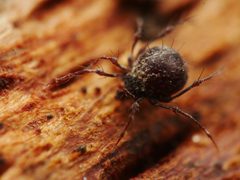
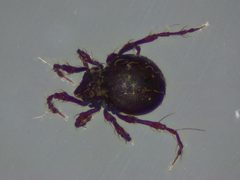
2Damaeidae is a of oribatid mites (order Sarcoptiformes) comprising approximately 20 distributed across the Northern Hemisphere. Members are primarily fungivorous and inhabit decomposing organic matter including plant litter, mosses, decaying wood, and soil layers. Several exhibit troglophilic tendencies, occurring in subterranean such as caves and mountain scree systems. The family has undergone extensive taxonomic revision, with historically recognized families Belbidae, Belbodamaeidae, and Hungarobelbidae now synonymized under Damaeidae.

Pronunciation
How to pronounce Damaeidae: //ˌdæm.iˈaɪ.diː//
These audio files are automatically generated. While they are not always 100% accurate, they are a good starting point.
Identification
Damaeidae can be distinguished from other oribatid by a combination of morphological characters including: bothridial setae typically present (often flagellate in some ); notogastral setae usually barbed and longitudinally oriented; spina adnata present and often strongly bent; and specific arrangements of epimeral setae. Genera within the family are differentiated by features such as the development of the famulus on I, the form of prodorsal sculpturing (including unusual alveolate patterns in some Dyobelba ), and the configuration of notogastral setae and . Subgenera within Damaeus sensu lato (including Adamaeus, Paradamaeus, and Damaeus s. str.) are distinguished by subtle differences in leg chaetotaxy and body ornamentation.
Images
Habitat
Forest floor microhabitats including leaf litter, moss carpets, decaying wood, and organic soil horizons. Prairie sod, fens, and subalpine scree slopes. Subterranean environments: caves (eutroglophilic ), mountain scree of the Mesovoid Shallow Substratum (MSS), and deep soil cracks. Approximately 80% of damaeid species in surveyed Carpathian systems occurred in MSS habitats versus environments.
Distribution
Holarctic distribution with primary occurrence in Eurasia and North America. European records span from Scandinavia to the Mediterranean, including Carpathian, Caucasian (Georgia), and Crimean cave systems. North American range includes eastern and midwestern USA, southern Appalachian Mountains, Ontario (Canada), and New Hampshire. Asian distribution includes Russia, Central Asia, China, and Japan. Disjunct reported from New Zealand and South America (taxonomic status requires verification).
Diet
Fungivorous; feeds on fungal and spores.
Life Cycle
Development includes , larva, , deutonymph, tritonymph, and stages. Complete ontogeny has been described for several including Kunstidamaeus lengersdorfi, K. arthurjacoti, Dyobelba dindali, and Damaeus kovali. stages inhabit the same substrates as adults. In at least one cave-dwelling species (Damaeus kovali), the entire development cycle occurs within subterranean .
Behavior
Most are confined to decomposing plant material and organic soil layers. Some species exhibit troglophilic , with completing full in cave environments without developing obvious troglomorphic features. In MSS , species distribution patterns differ significantly between scree and environments, suggesting microhabitat specialization.
Ecological Role
Regulates of plant-pathogenic fungi through . Contributes to decomposition processes and nutrient cycling in forest floor and subterranean . In Carpathian MSS systems, Damaeidae represented the oribatid mite group, with Kunstidamaeus lengersdorfi as the most abundant .
Similar Taxa
- Belbidae (sensu stricto, historical concept)Previously treated as separate ; now synonymized with Damaeidae based on shared morphological characters and overlapping generic concepts.
- Other Brachypylina families (e.g., Oribatulidae, Scheloribatidae)Distinguished by the combination of bothridial setae structure, notogastral setae orientation, and specific arrangements of epimeral and leg setae; Damaeidae typically show more pronounced prodorsal sculpturing and specific famulus development.
More Details
Taxonomic History
The has undergone repeated taxonomic consolidation. Belbidae (Willmann 1931), Belbodamaeidae (Bulanova-Zachvatkina 1967), and Hungarobelbidae (1996) were successively recognized as junior synonyms. Recent revisions have restructured generic concepts within Damaeus sensu lato, elevating Epidamaeus, Kunstidamaeus, and Spatiodamaeus to generic status while retaining Adamaeus, Paradamaeus, and Damaeus s. str. as subgenera of Damaeus.
Subterranean Ecology
Damaeidae includes one of the most troglophilic-rich lineages among oribatid mites. In the Romanian Carpathians, damaeids dominated MSS , with K. lengersdorfi comprising the majority of individuals. Cave-dwelling such as Damaeus kovali and D. kizilkobensis complete development underground without morphological to subterranean life, representing eutroglophiles rather than troglobites.
Sources and further reading
- BugGuide
- Wikipedia
- GBIF taxonomy match
- iNaturalist taxon
- NCBI Taxonomy
- Catalogue of Life
- Notes on the subgenus Tectodamaeus (Acari: Oribatida: Damaeidae), with the description of a new species from China
- Taxonomy of European Damaeidae (Acari: Oribatida) I. Kunstidamaeus Miko, 2006, with comments on Damaeus sensu lato
- Kunstidamaeus arthurjacoti sp. nov. (Oribatida, Damaeidae), first report of the genus in North America
- Redescription of Belba paracorynopus Bulanova-Zachvatkina, 1962 (Acarina: Oribatida: Damaeidae) from Georgia
- Taxonomy of European Damaeidae (Acari: Oribatida) VII. Redescription of Neobelba pseudopapillipes Bulanova-Zachvatkina, 1967 with comments on its generic status
- Taxonomy of European Damaeidae (Acari: Oribatida) VI. The oribatid mite genus Parabelbella: Redescription of P. elisabhetae and synonymy of Akrodamaeus
- The Dyobelba tectopediosa species-group (Acari: Oribatida: Damaeidae) from the Southeastern USA, with a key to world species of Dyobelba and notes on their distribution
- Damaeid mite species (Acari, Oribatida, Damaeidae) and their occurrence in subterranean habitats. A case study from the Romanian Carpathians
- Review of Damaeus (Acari: Oribatida: Damaeidae) from Crimea with description of two new cave-dwelling species
- Redescriptions of North American Epidamaeus (Acari, Oribatida, Damaeidae) species proposed by N. Banks, H.E. Ewing, A.P. Jacot, and J.W. Wilson