
Cymbaeremaeidae
Sellnick, 1928
Genus Guides
1Cymbaeremaeidae is a of oribatid mites (Acari: Oribatida) comprising approximately 5 and at least 90 described . The family includes the genera Cymbaeremaeus, Scapheremaeus, Bulleremaeus, Glanderemaeus, and Seteremaeus. Members of this family have been documented across multiple continents including Asia, Australia, North America, and South America, with ranging from forest soil and litter to arboreal environments and temporary rock pools.
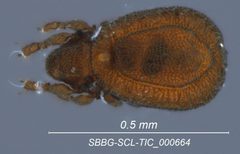
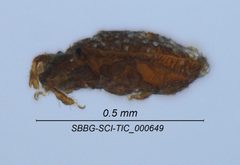
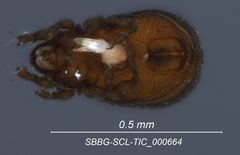
Pronunciation
How to pronounce Cymbaeremaeidae: /sɪmˌbɛərəˈmaɪɪdiː/
These audio files are automatically generated. While they are not always 100% accurate, they are a good starting point.
Identification
Cymbaeremaeidae can be distinguished from other oribatid by morphological characteristics of the Scapheremaeus, which shows two main morphological categories: with a complete circumdorsal scissure and plicate microsculpture on the circumnotogastral plate with strongly contrasting microsculpture (foveolae, ridges or ) on the centrodorsal plate; and species with little or no contrast in microsculpture between central and lateral regions, typically both regions foveolate or reticulate. instars of Scapheremaeus are characterized by the presence of exuvial scalps on nymphal instars and distinctive gastronotic setae .
Images
Habitat
include soil and litter of various forests, mosses growing on rocks, and arboreal environments. Specific documented habitats include: semi-arid Mallee eucalypt vegetation in South Australia; branches of Lauraceae trees in Vietnam; temporary rock pools with mosses (Grimmia laevigata) on granitic outcrops in Georgia, USA; and arboreal habitats in Florida, USA.
Distribution
Documented from Southern Japan, Eastern China, South Australia, southern Vietnam, Georgia and Florida in the USA, Mexico, and South America. One (Scapheremaeus palustris) has a trans-Atlantic distribution. The Scapheremaeus has been described as having distribution. Distribution records from GBIF include Denmark, Norway, and Sweden.
Life Cycle
Development includes larval and nymphal instars. Nymphal instars are characterized by the presence of exuvial scalps retained from previous instars. Larval instar of Scapheremaeus tonatiuh has gastronotic setae c3, la, lm, lp long and with setiform apex, and h1 very long and subflagellate. Nymphal instars have 12 pairs of gastronotic setae with da, dm, dp absent.
Similar Taxa
- ScutoverticidaeGenetic analysis of 28S D3 rRNA identifies Scutoverticidae (Scutovertex, Provertex, Exochocepheus) as among the closest relatives to Scapheremaeus
- EremaeozetidaeGenetic analysis identifies Eremaeozetidae (Eremaeozetes) as among the closest relatives to Scapheremaeus
- AmeronothridaeGenetic analysis identifies Ameronothridae (Ameronothrus) as among the closest relatives to Scapheremaeus; Scapheremaeus petrophagus was previously misassigned to this superfamily
- PhenopelopidaeGenetic analysis identifies Phenopelopidae (Eupelops) as among the closest relatives to Scapheremaeus
Sources and further reading
- BugGuide
- Wikipedia
- GBIF taxonomy match
- iNaturalist taxon
- NCBI Taxonomy
- Catalogue of Life
- Two new species of Scapheremaeus from Southern Japan (Acari: Oribatida: Cymbaeremaeidae), with genetic information
- Ontogenetic instars of a new species of the genus Scapheremaeus (Acari, Oribatida, Cymbaeremaeidae) from Vietnam
- Description of juvenile instars of Scapheremaeus tonatiuh Palacios-Vargas, Ríos & Vázquez, 1998 (Acari, Oribatida, Cymbaeremaeidae)
- Comparative morphology and species-groups of the oribatid mite genus Scapheremaeus (Acari: Oribatida: Cymbaeremaeidae), with new species from South Australia
- Scapheremaeus rodickae n. sp. (Acari: Oribatida: Cymbaeremaeidae) associated with temporary rock pools in Georgia, with key to Scapheremaeus species in eastern USA and Canada