
Ameronothridae
Vitzthum, 1943
Genus Guides
1Ameronothridae is a of oribatid mites comprising approximately 8 and at least 30 described . The family is predominantly distributed in Holarctic cold-temperate and polar coastal regions, with some occurring far inland on anthropogenic structures. Members are primarily intertidal inhabitants of rocky shorelines, with documented lichenivorous feeding habits. The family includes notable genera such as Ameronothrus, Halozetes, Alaskozetes, and Podacarus.
Pronunciation
How to pronounce Ameronothridae: //æ.mɛ.roʊˈnɒθ.rɪˌdiː//
These audio files are automatically generated. While they are not always 100% accurate, they are a good starting point.
Identification
Ameronothridae can be distinguished from other oribatid by features including pusticulate body surface ornamentation and, in some , loss of companion setae d on all genua in . Juveniles often share similar body surface patterns with adults. Species-level identification requires examination of leg chaetotaxy, body surface microsculpture, and other fine morphological details.
Images
Habitat
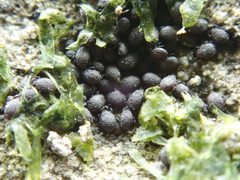
Primarily coastal environments including sediment-free rocky substrates, spray zones on quay walls, and upper eulittoral areas on large rocks. Some occur on moss and lichen growing on anthropogenic structures such as historic building stone far from coastlines. Associated with grey lichen in spray zones and dark green on rocky surfaces.
Distribution
Holarctic cold-temperate and polar regions: European coasts (Northern and Baltic Seas, Atlantic shores, Mediterranean), Greenland, arctic islands, Pacific North American coast (Alaska to California), Atlantic North American coast, Russian Far East (Kamchatka, Kuril Islands), Hokkaido Japan, Denmark, Norway, Sweden. Some occur far upstream beyond estuary edges in Northern Europe.
Diet
Lichenivorous; feeds on lichen, , and fungi.
Life Cycle
Ontogenetic stages include , instars, and . Juvenile has been documented for some , showing similar body surface patterns to adults.
Behavior
have been observed to persist for decades in subject to high human disturbance, including tourist destinations with over 14 million visitors. Some colonize anthropogenic structures far from their typical coastal range.
Ecological Role
Inhabitant of ; part of intertidal mite fauna contributing to decomposition and nutrient cycling in coastal .
Human Relevance
have been documented on historic buildings including the Cathédrale Notre-Dame de Paris, where they were first discovered approximately 50 years ago and have persisted despite intensive tourism. sequences from such populations have been used for taxonomic confirmation and biogeographic studies.
Similar Taxa
- Other Oribatida familiesAmeronothridae is distinguished by its coastal intertidal preference, pusticulate body surface, and specific leg chaetotaxy reductions; other oribatid typically occupy terrestrial soil and litter habitats with different morphological adaptations.
More Details
Notable Genera
The includes Alaskozetes, Ameronothrus, Aquanothrus, Capillibates, Chudalupia, Halozetes, Podacarus, and Pseudantarcticola. Ameronothrus maculatus and A. yoichi have been subjects of detailed morphological and molecular study.
Molecular Data
sequences for COI, 18S, 5.8S, 28S genes, and elongation factor 1 alpha have been obtained for some , with COI sequences showing minimal divergence (single base difference) between geographically separated .
Sources and further reading
- BugGuide
- Wikipedia
- GBIF taxonomy match
- iNaturalist taxon
- NCBI Taxonomy
- Catalogue of Life
- First record of the family Ameronothridae (Acari: Oribatida) from Japan – new species, juvenile morphology, ecology and biogeographic remarks
- Coastal mites (Oribatida, Ameronothridae) found far from the coast in moss growing on the Cathédrale Notre-Dame de Paris, France, fifty years after their first discovery in this historic site