
Sarcoptidae
Itch Mites
Genus Guides
1- Sarcoptes(itch mite)
Sarcoptidae is a of parasitic mites in the order Sarcoptiformes, commonly known as itch mites. The family includes the Sarcoptes, whose members cause sarcoptic mange in mammals. These mites are obligate that burrow into skin, causing intense pruritus, crusting , and potentially fatal secondary . Sarcoptes scabiei, the most studied , infests over 200 million humans worldwide and numerous domestic and wild mammal species.
Pronunciation
How to pronounce Sarcoptidae: /sɑrˈkɒptɪdiː/
These audio files are automatically generated. While they are not always 100% accurate, they are a good starting point.
Identification
Sarcoptidae are distinguished from other astigmatid mites by their parasitic lifestyle, burrowing in mammalian skin, and morphological fusion of tibia and on leg IV. Within the , Notoedres is distinguished from Sarcoptes by shield and association patterns. Identification to level requires microscopic examination of setal lengths, shield configurations, and genital arrangements at 40x magnification or higher. Sarcoptes scabiei strains are morphologically similar but show host specificity; molecular methods may be required for strain differentiation.
Images
Appearance
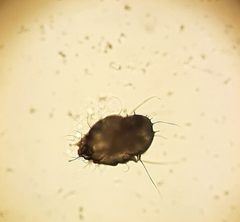
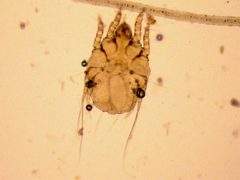
Small, round to oval mites with a globose elongated idiosome. Females possess a short, broad gnathosoma and short, thick legs with tibia and IV . apodeme is fused with genital . Anal shields are not fused to the median shield. Setae vi length and setae e2/h1, h2 length ratios are taxonomically diagnostic. Larvae and nymphs are smaller with fewer leg pairs.
Habitat
Obligate of mammalian skin. Found in stratum corneum and superficial where mites construct burrows. Environmental persistence limited to brief survival off- in bedding, dens, resting areas, and burrows recently vacated by infested hosts. Associated with periurban areas, disrupted tropical dry forest, forested landscapes, and domestic settings with cattle farming and agricultural activity.
Distribution
Worldwide distribution with highest in tropical regions. Documented in North America (coyotes, red foxes, American black bears), South America (Ecuador, Chile, Peru, Argentina, Bolivia, Brazil, Colombia), Europe, Russia, India, and globally in human . Historical episodes recorded in Ecuador (1968-1973). GBIF records confirm presence in Denmark, Norway, and Sweden.
Diet
Feeds on epidermal , lymph, and dissolved skin proteins. Host have been detected in the mite gut, indicating blood-derived protein acquisition. Does not feed on plant material or free-living organisms.
Host Associations
- Homo sapiens - primary Over 200 million people affected worldwide; causes
- Canis familiaris - primary Domestic dogs; major for wildlife spillover
- Vulpes vulpes - primary Red foxes; historically affected with high mite burdens
- Canis latrans - primary Coyotes; commonly affected in North America
- Ursus americanus - primary American black bears; emerging in Mid-Atlantic and Northeast US
- Lycalopex sechurae - documented Sechuran fox; first report in Ecuador 2022
- Felis catus - documented Domestic cats
- Sus domesticus - documented Domestic pigs; causes growth reduction and behavioral changes
- Bos taurus - documented Cattle
- Oryctolagus cuniculus - documented Rabbits
- Lama glama - documented Llamas
- Vicugna pacos - documented Alpacas
- Myotis ikonnikovi - documented Ikonnikov's bat; first Sarcoptidae record on bats in Russia
- Rattus rattus - documented Black rat; records from India
- Rattus norvegicus - documented Brown rat; records from India
- Pteropus giganteus - documented Indian flying fox; records from India
- Various Chiroptera - documented Multiple bat from India and Russia
Life Cycle
Direct with no free-living stages. Females burrow into stratum corneum and deposit in tunnels. Eggs hatch into larvae, which develop through and tritonymph stages before maturing to . All developmental stages occur on the . time approximately 10-14 days under optimal conditions. Males emerge from burrows to seek females on skin surface.
Behavior
Females construct permanent burrows in superficial for -laying and shelter. Transmission occurs through direct skin-to-skin contact during allogrooming, mating, or fighting. Indirect transmission via contaminated dens, resting areas, bedding, or burrows is possible but limited by short off- survival. Highly contagious; causes episodes in wildlife . induces intense pruritus leading to scratching, alopecia, and secondary behavioral changes in hosts.
Ecological Role
Significant threat to biodiversity conservation through -mediated mortality in wildlife . Facilitates cross- transmission between domestic/ animals and native . Feral dogs are particularly influential in disease spillover to wildlife. Acts as emerging infectious disease agent with potential in susceptible . Not known to provide beneficial services.
Human Relevance
Major human health concern: Sarcoptes scabiei causes , classified by WHO as a neglected tropical affecting over 200 million people globally. Two clinical forms: ordinary scabies (intense pruritus, papular rash) and crusted scabies (hyperkeratotic crusts, high mite burden, potentially fatal secondary bacterial ). Crusted scabies occurs primarily in immunocompromised individuals. Zoonotic potential exists but -adapted strains show specificity. Veterinary importance: causes sarcoptic mange in livestock and companion animals, reducing growth performance and requiring treatment (e.g., ivermectin 0.4 mg/kg subcutaneous weekly for 3 weeks). Wildlife management concern due to impacts.
Similar Taxa
- PsoroptidaeAlso causes mange in mammals but are non-burrowing surface feeders with longer legs and different tarsal structure; found on skin surface rather than in tunnels
- DemodicidaeParasitic with elongated, worm-like body form and different (hair follicles and sebaceous glands rather than epidermal burrows)
- MyobiidaeAssociated with bats and rodents like some Sarcoptidae, but are fur mites with different leg structure and do not burrow; distinguished by claw and location on pelage rather than skin
More Details
Immunology
immune response involves both innate and adaptive components. Ordinary shows CD4+ T- dominance with mixed TH1/TH2 protective profile. Crusted scabies shows CD8+ T-cell mediation with TH2/TH17 non-protective profile and early immunosuppression followed by deleterious response to uncontrolled mite proliferation.
Surveillance Methods
Traditional relies on skin scrapes with microscopic identification. Quantitative methods using 6-mm punch biopsies digested in potassium hydroxide (55°C, 12 hours) enable mite burden assessment for research and surveillance in wildlife .
Taxonomic Note
Notoedres, also in Sarcoptidae, contains parasitic on bats and other mammals. Notoedres alinae was described from Myotis ikonnikovi in Siberia, representing the first Sarcoptidae record on bats in Russia. Notoedres species differ from Sarcoptes in shield and typically cause notoedric mange with different distribution.
Sources and further reading
- BugGuide
- Wikipedia
- GBIF taxonomy match
- iNaturalist taxon
- NCBI Taxonomy
- Catalogue of Life
- First report of Sarcoptes scabiei parasitism (Sarcoptiformes: Sarcoptidae) in Lycalopes sechurae (Mammalia: Carnivora)
- New Host And Distribution Records Of Acarina (Myobiidae, Sarcoptidae, Teinocoptidae) From India1
- Growth Performance and Behavioral Patterns of Pigs Infested with Sarcoptic Mites (Acari: Sarcoptidae)
- A Tissue Digestion Protocol for Measuring Sarcoptes scabiei (Astigmata: Sarcoptidae) Density in Skin Biopsies
- Pruritus and Behavior of Pigs Infested by Itch Mites Sarcoptes scabiei (Acari: Sarcoptidae)
- Presence of Host Immunoglobulin in the Gut of Sarcoptes scabiei (Acari: Sarcoptidae)
- Immune mechanisms in humanSarcoptes scabiei(Acari: Sarcoptidae) infestations
- Host Specificity of S. scabiei var. canis (Acari: Sarcoptidae) and the Role of Host Odor
- The first record of a scabies mite of the family Sarcoptidae (Acari, Sarcoptiformes) associated with Chiroptera in Russia