
Rhipiceridae
Latreille, 1834
Cicada-Parasite Beetles
Genus Guides
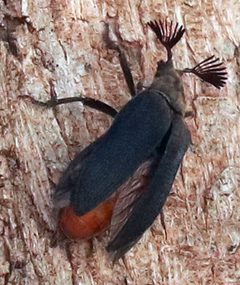
1is a of beetles specialized as of nymphs. Larvae exhibit , with mobile planidial first instars that actively locate and penetrate underground cicada nymphs, developing as endoparasitoids until death. display pronounced : males possess large with approximately 30,000 placodea for detecting chemical cues, while females have compact bodies with simple antennae bearing around 100 sensilla. The family comprises seven and approximately 100 described divided into two : Rhipicerinae (Australia, New Caledonia, Chile) and Sandalinae (Americas, Africa, Europe, Asia).
Pronunciation
How to pronounce Rhipiceridae: /rɪˈpɪsərɪˌdiː/
These audio files are automatically generated. While they are not always 100% accurate, they are a good starting point.
Identification
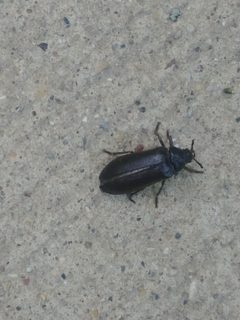
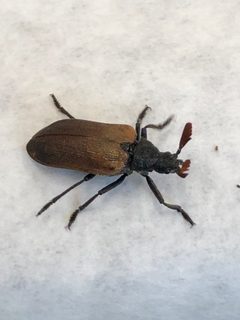
Males distinguished by large or used for detecting female ; females have simple, unmodified antennae. Rhipicerinae characterized by antennae with more than 11 antennomeres, well-developed maxillary , and incomplete lateral pronotal carina. of Sandalus niger are brown to black in coloration. Larvae are planidial (highly mobile first instar) with reduced legs and specialized for subterranean movement; mature larvae have sclerotized terminal segments and reduced appendages.
Images
Habitat
Subterranean soils near , particularly forest soils where cicada nymphs occur. found on vegetation including maple trees and areas with dead or decaying trees. deposition sites include bark holes and fissures where cicadas oviposit, such as elm bark.
Distribution
Worldwide but patchy: Sandalinae widespread across North and South America, Africa, southeastern Europe, and Asia; Rhipicerinae restricted to Chile, New Caledonia, and Australia. Specific records include: western Palearctic and Maghreb countries (Arrhaphipterus); tropical, subtropical, and southern Africa (Chamoerrhipes); Chile (Polymerius); Australia and New Caledonia (Rhipicera, Oligorhipis); southern South America (Polytomus); North America (Sandalus).
Seasonality
tracks emergence patterns; adults active during periods corresponding to availability. Adults frequently attracted to lights at night.
Diet
Larvae: endoparasitic, feeding on and internal tissues of nymphs. : observed feeding on plant sap, nectar, fruit, and small insects.
Host Associations
- Cicada nymphs - primary Larvae are external that become endoparasitic after penetrating
- Underground cicada nymphs - Planidial larvae actively locate and attach to subterranean nymphs
- Cicada pupae - may die before
Life Cycle
Hypermetamorphic with distinct larval morphologies across instars. deposited in soil or bark fissures near . First-instar planidial larvae hatch and actively search for underground cicada nymphs, attaching and penetrating to establish as internal endoparasitoids. Development completed within host, which dies before . occurs underground or in soil. Adults emerge and are generally short-lived.
Behavior
Male beetles exhibit upwind zigzag or upwind-facing perching consistent with scent-tracking. Males adopt prominent upright positions on high points when searching for females. are largely inactive and motionless, flying only for mating ('blind dates'). Planidial larvae demonstrate active -searching behavior in soil. Adults attracted to lights at night.
Ecological Role
of cicadas, acting as natural biocontrol agents that may limit severity. Serve as indicators of soil biodiversity and cicada abundance. Contribution to nutrient cycling through -host interactions in subterranean .
Similar Taxa
- RipiphoridaeBoth exhibit with planidial larvae and ; historically confused or discussed together in literature. Ripiphoridae parasitize hymenopterans and wood-boring beetles rather than cicadas, and show broader diversity.
- DascillidaeSister within superfamily Dascilloidea; share general body form but lack the extreme antennal dimorphism and specialized larval of .
Sources and further reading
- BugGuide
- Wikipedia
- GBIF taxonomy match
- iNaturalist taxon
- NCBI Taxonomy
- Catalogue of Life
- Parasitoid Beetles of the Families Rhipiceridae and Ripiphoridae (Coleoptera): Biology, Ecology, and Evolutionary Insights
- Towards an Understanding of Molecule Capture by the Antennae of Male Beetles Belonging to the Genus Rhipicera (Coleoptera, Rhipiceridae)