
Sandalus niger
Knoch, 1801
cedar beetle, cicada parasite beetle
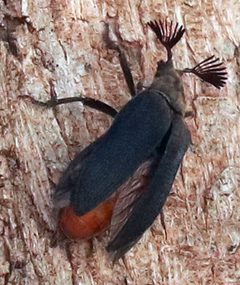
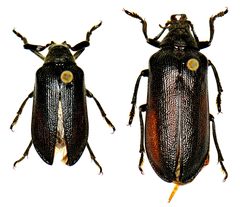
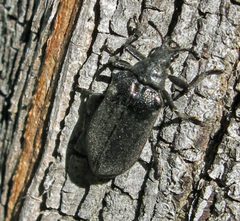
Sandalus niger is a in the Rhipiceridae, found in North America. Both sexes are capable of , though females are frequently observed motionless on elm tree trunks. Males fly during afternoon hours when temperatures range from 15°C to 30°C, becoming immobilized below 15°C. After mating, females ascend to heights of 10 meters or more in elm trees to deposit in bark crevices or holes.
Pronunciation
How to pronounce Sandalus niger: //ˈsændələs ˈnaɪɡər//
These audio files are automatically generated. While they are not always 100% accurate, they are a good starting point.
Images
Habitat
Associated with elm (Ulmus) trees, where females are found on trunks and both sexes utilize bark for oviposition sites. Specific requirements beyond elm association are not documented.
Distribution
North America. Records include Ontario, Canada.
Seasonality
activity occurs during afternoon hours when ambient temperatures exceed 15°C. Specific seasonal timing of or peak activity is not documented.
Host Associations
- elm (Ulmus) - oviposition siteFemales deposit in holes or behind bark of elm trees, typically at heights of 10 meters or above
Life Cycle
Females release in holes or behind elm bark at considerable height (10+ meters) following mating. Larval development and complete details are not documented in available sources.
Behavior
Males fly throughout the afternoon when temperatures are favorable (15–30°C), ceasing activity below 15°C. During mating periods, males remain motionless and do not fly. Females are typically observed motionless on elm tree trunks, though capable of . Post-mating, females actively climb to elevated positions in trees before ovipositing.
Ecological Role
Known as a ' ,' though specific parasitic relationships with cicadas are not detailed in available sources. The suggests potential association with cicada , but this relationship is not explicitly confirmed.
More Details
Taxonomic note
placement in Rhipiceridae (formerly sometimes treated as part of Callirhipidae or as a distinct family). The ' ' implies , but the specific nature of this relationship requires verification from primary literature.
Sources and further reading
- BugGuide
- Wikipedia
- GBIF taxonomy match
- iNaturalist taxon
- NCBI Taxonomy
- Not Just Maize: Africa's Fall Armyworm Crisis Threatens Sorghum, Other Crops, Too
- Eavesdropping on Soybean Weevils: Scientists Detect Subtle Acoustic Signals
- Citizen scientists discover new plant species in the Cape Floral Kingdom | Blog
- How One Entomologist Rears Insects to Support Research and Development
- Meet the Recipients of the 2021 Black in Entomology Student Prizes
- New Study Reveals Natural Enemies of Fall Armyworm in Both Asia and Africa