
Pediciidae
Hairy-eyed Crane Flies
Genus Guides
4, commonly known as hairy-eyed crane flies, is a of about 500 worldwide. They are medium-sized to large flies (5–35 mm) closely related to true crane flies (Tipulidae). The family is distinguished by pubescent with short erect hairs between the , a trait absent in related families. They occupy diverse but are particularly associated with clean, cold aquatic environments. The family was established as a separate lineage from Tipulidae based on morphological and molecular evidence, representing one of two primary lineages within the superfamily .
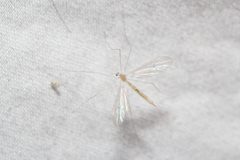
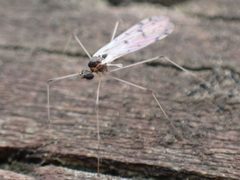
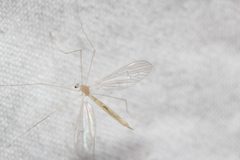
Pronunciation
How to pronounce Pediciidae: //pɛˈdɪsi.aɪdiː//
These audio files are automatically generated. While they are not always 100% accurate, they are a good starting point.
Identification
Distinguished from Tipulidae and other crane fly by the presence of pubescent with short erect hairs between the ; related families typically have glabrous . The V-shaped transverse on the and the wing venation pattern (two anal , oblique line formed by crossveins and M-Cu) provide additional diagnostic characters. -level identification often requires examination of male genital structures. In Dicranota, a short radial sector in the wing venation is diagnostic for the .
Images
Appearance
Medium-sized to large flies with long, slender wings, legs, and . Body length ranges from 5 mm (Dicranota) to 35 mm (Pedicia). The are pubescent with short erect hairs present between the ; ocelli are absent. possess 12–17 segments. The has a V-shaped transverse . Wings have two anal , with crossveins and M-Cu forming an oblique line. Some , particularly in Pedicia, exhibit contrasting brown longitudinal stripes on wings. Wing dimorphism occurs in some species, with brachypterous individuals present, especially at high altitudes or in cold climates.
Habitat
Primarily associated with forested mountain regions and clean, cold aquatic including small fast-running streams, springs, and stream margins. are typically found in herbaceous vegetation near water bodies. Some occupy wet logs and other damp terrestrial environments. The shows a strong association with pristine, cold-water , with larvae developing on the bottoms of streams and springs.
Distribution
Worldwide distribution with approximately 500 . Well-documented from the Holarctic region including Europe, Russia (Caucasus, Siberia), Japan, Korean Peninsula, and North America. Also present in the Oriental region (Taiwan, India, Himalayas) and Mongolia. In Europe, species occur from Portugal and the Azores to Scandinavia. The Heterangaeus extends into north-central Mongolia, representing a significant eastern range extension.
Seasonality
are active primarily during spring and summer months. Activity patterns vary by ; some are , becoming more active at dusk. Adults of some species are attracted to light. In temperate regions, activity is concentrated in the warmer months, with specific timing varying by elevation and local climate conditions.
Life Cycle
Larvae are aquatic, developing on the bottoms of streams, springs, and other clean cold-water . The larval stage is the longest phase of the . occurs in or near the aquatic habitat. are short-lived, typically surviving only a matter of days to weeks. Adult feeding is minimal; some may sponge up liquids such as dew, and some with elongated mouthparts visit flowers for nectar.
Behavior
hide in herbaceous vegetation during daylight hours and become more active at dusk. Some form swarms close to the ground at dusk. Adults are often observed flying near water bodies, sometimes in association with other such as Tricyphona. Some species exhibit wing dimorphism, with males sometimes having extended wing margins and females occasionally brachypterous; high-altitude or cold-climate species may be entirely brachypterous. Adults are not predatory and do not bite or sting.
Ecological Role
Larvae function as in clean, cold-water stream , feeding on small . They serve as indicators of high-quality aquatic due to their requirement for pristine, cold-water conditions. The contributes to nutrient cycling in headwater stream systems and serves as prey for aquatic and terrestrial predators.
Human Relevance
are harmless and do not bite, sting, or feed on blood. They are sometimes mistaken for mosquitoes or large predatory insects, but these perceptions are erroneous. The has no known economic importance as pests or beneficial . They are of interest to entomologists and aquatic ecologists as bioindicators of water quality and subjects of taxonomic study.
Similar Taxa
- TipulidaeTrue crane flies share the general body plan of long legs, slender wings, and elongated , but lack the diagnostic pubescent of . Tipulidae typically have glabrous eyes and different thoracic patterns.
- LimoniidaeLimoniid crane flies are generally smaller with more varied body forms, and like Tipulidae, possess glabrous rather than the hairy characteristic of .
- TrichoceridaeWinter crane flies have a superficially similar appearance but differ in structure, wing venation, and are typically active during colder months.
More Details
Taxonomic History
was recognized as a distinct separate from Tipulidae based on phylogenetic studies combining and molecular data (Petersen et al., 2010). This conservative approach maintained Tipulidae as the bulk of crane fly diversity while separating Pediciidae as a sister group. The family contains two : Pediciinae and Ulinae. Fossil record extends to the Jurassic period.
Wing Dimorphism
Several exhibit wing dimorphism, with both fully winged and brachypterous individuals occurring within . This phenomenon is particularly associated with high-altitude and cold-climate , where reduced wings may provide energetic or aerodynamic advantages.
Sources and further reading
- BugGuide
- Wikipedia
- GBIF taxonomy match
- iNaturalist taxon
- NCBI Taxonomy
- Catalogue of Life
- Mosquito Hawk? Skeeter Eater? Giant Mosquito? No, No, and No
- Dicranota Zetterstedt, 1838 crane flies (Diptera, Pediciidae) of Korea
- Revision of Japanese species of Nipponomyia Alexander, 1924 (Diptera, Pediciidae)
- Crane and Winter Flies (Diptera: Limoniidae, Pediciidae, Trichoceridae) Associated with Fungi in Lithuania
- New for the Central Caucasus: Dicranota parviuncinata Sav. (Diptera: Pediciidae), with data on its distribution and ecology
- Discovery of the second European Amalopis species: an integrative survey of the widespread Pedicia (Amalopis) occulta (Meigen, 1830) (Insecta, Diptera, Pediciidae)
- <strong>New records for Limoniidae and Pediciidae (Diptera) from the Caucasus, Russia</strong>
- New records of West Palaearctic Limoniidae, Pediciidae and Cylindrotomidae (Diptera) from the collections of the Zoological Museum, Amsterdam
- A new species of Heterangaeus Alexander, 1925 crane flies (Diptera: Pediciidae) from north-central Mongolia with first description of the larva for the genus
- <strong>Crane flies—history, taxonomy and ecology (Diptera: Tipulidae, Limoniidae, Pediciidae, Trichoceridae, Ptychopteridae, Tanyderidae)</strong>
- On the morphology and ecology of the previously unknown larva of the short-palped crane fly Nasiternella varinervis (Zetterstedt, 1851) (Diptera, Pediciidae)
- Description of the larva and pupa of Nasiternella regia Riedel, 1914 (Diptera: Pediciidae) from Slovakia, with notes on ecology and behaviour
- The InBIO Barcoding Initiative Database: DNA barcodes of Portuguese Diptera 02 - Limoniidae, Pediciidae and Tipulidae