
Paronellidae
Börner, 1906
Genus Guides
2is a of elongate-bodied springtails (Collembola) in the order Entomobryomorpha. The family contains approximately 18 and at least 90 described . Members of this family are primarily distributed in tropical and subtropical regions, with many species adapted to subterranean including caves. The family includes notable troglobitic genera such as Troglobius and Troglopedetes.
Pronunciation
How to pronounce Paronellidae: //ˌpærəˈnɛlɪˌdeɪ//
These audio files are automatically generated. While they are not always 100% accurate, they are a good starting point.
Identification
Distinguished from other Entomobryomorpha by combination of elongate body, scaled , and specific antennal and dental chaetotaxy patterns. Antennal chaetotaxy provides diagnostic characters: distribution patterns of , ordinary , S-chaetae, and subapical organites differ markedly between and surfaces and between antennal segments. Dental spine number and arrangement on used to distinguish groups. Caves in tropical regions often harbor troglobitic species with reduced pigmentation and .
Images
Appearance
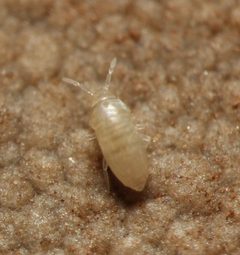
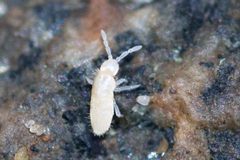
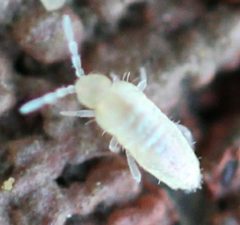
Elongate-bodied springtails with slender, cylindrical body form. Body covered with and various types of . well-developed, with complex chaetotaxy including scales, ordinary chaetae, S-chaetae, and subapical organites. Dental spines present on the in some , with grouped by numbers of spines (bidenticulati, tridenticulati groups).
Habitat
Diverse including leaf litter, soil, and grassland . Many are troglobitic, restricted to cave environments including limestone caves and iron ore caves. Some species occur in deep soil habitats.
Distribution
Tropical and subtropical regions worldwide. Documented from Brazil (Amazon region, iron caves), Thailand (cave systems south of Kra Isthmus), India (Bihar, Odisha, northeastern states), and Nepal. iNaturalist records indicate broad tropical distribution with 2905 observations.
Host Associations
- Microtrombidiidae mite (Parasitengona) - Mite attaches to of by stylostome; first reported in Trogolaphysa from Brazilian caves
Ecological Role
Important component of cave fauna in tropical regions. As Collembola, contribute to soil building and nutrient cycling where they occur in soil and leaf litter .
Similar Taxa
- EntomobryidaeAlso elongate-bodied Entomobryomorpha; distinguished by 's scaled and specific antennal chaetotaxy patterns
- CyphoderidaeSometimes treated as Cyphoderinae within ; separation based on antennal and dental
More Details
Taxonomic significance of antennal chaetotaxy
Detailed study of Troglopedetes revealed 20 distinct types of antennal with species-specific distribution patterns. This morphological diversity provides powerful characters for distinguishing species and within the .
Cave adaptation
Multiple contain troglobitic showing convergent adaptations to subterranean life, including Troglobius from Brazilian iron caves and Troglopedetes from Thai and Nepalese cave systems.
Sources and further reading
- BugGuide
- Wikipedia
- GBIF taxonomy match
- iNaturalist taxon
- NCBI Taxonomy
- Catalogue of Life
- Two new Cyphoderus (Collembola: Paronellidae) of “tridenticulati” and “bidenticulati” groups from Brazilian Amazon
- Figure 2 from: Oliveira MPA, Bernardi LFO, Zeppelini D, Ferreira RL (2016) First report of cave springtail (Collembola, Paronellidae) parasitized by mite (Parasitengona, Microtrombidiidae). Subterranean Biology 17: 133-139. https://doi.org/10.3897/subtbiol.17.8451
- <i>Cyphoderopsis nepalensis</i> (Wilson, 1982): A New Record of Collembola (Entomobryomorpha: Paronellidae) from India
- First report of Dicranocentroides indica (Handschin, 1929) (Collembola: Paronellidae) from Odisha, India
- Figure 14 from: Zeppelini D, Silva D, Palacios Vargas J (2014) A new species of Troglobius (Collembola, Paronellidae, Cyphoderinae) from a Brazilian iron cave. Subterranean Biology 14: 1-13. https://doi.org/10.3897/subtbiol.14.7355
- Figure 15 from: Zeppelini D, Silva D, Palacios Vargas J (2014) A new species of Troglobius (Collembola, Paronellidae, Cyphoderinae) from a Brazilian iron cave. Subterranean Biology 14: 1-13. https://doi.org/10.3897/subtbiol.14.7355
- The multiformity of antennal chaetae in Troglopedetes Joseph, 1872 (Collembola, Paronellidae, Troglopedetinae), with descriptions of two new species from Thailand
- Figure 9 from: Zeppelini D, Silva D, Palacios Vargas J (2014) A new species of Troglobius (Collembola, Paronellidae, Cyphoderinae) from a Brazilian iron cave. Subterranean Biology 14: 1-13. https://doi.org/10.3897/subtbiol.14.7355