
Monotomidae
Laporte, 1840
Minute Clubbed Beetles
Subfamily Guides
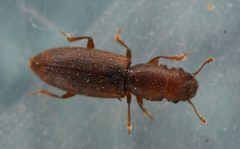
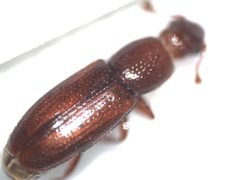
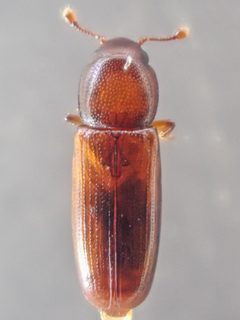
2is a of small beetles in the superfamily Nitiduloidea, containing approximately 240 in 33 . The family exhibits diverse ecological habits: members occur under tree bark, in decaying vegetation, on flowers, and in nests. Some species are mycophagous, feeding on ascomycete fungi, while others are predatory. The genus Rhizophagus includes species that prey on bark beetles and their stages.
Pronunciation
How to pronounce Monotomidae: //mɒnəˈtɒmɪdiː//
These audio files are automatically generated. While they are not always 100% accurate, they are a good starting point.
Images
Habitat
Members of this occupy diverse microhabitats including: under tree bark, in decaying vegetation, on flowers, and within nests. The Rhizophagus is specifically associated with low-altitude pine forests.
Distribution
Worldwide distribution. Recorded from Europe (Denmark, Norway, Sweden, France), North America (United States, including Vermont), and Asia (China, Myanmar, Lebanon, Spain). Fossil are known from Jurassic and Cretaceous deposits in China, Myanmar, Lebanon, and Spain.
Seasonality
Rhizophagus atticus shows highest activity in August. No -wide seasonality pattern established.
Diet
Ecologically diverse. Some are mycophagous, feeding on fruiting bodies of ascomycete fungi. Rhizophagus species are on bark beetles (, larvae, and young ) and possibly Phoridae larvae. Larvae of some species are mycophagous. Monotoma testacea has been successfully reared on baker's yeast in laboratory conditions.
Life Cycle
Complete . For Monotoma testacea: stage 5–6 days; first instar larva 2–3 days; second instar larva 3–5 days; third instar larva 2–5 days; immovable 12–13 days; pupa 7–10 days; total development from egg to 34–42 days. First instar larvae possess an arrow- of coarse asperities on the frontal region hypothesized to function as an egg-burster; this structure is absent in older instars.
Ecological Role
Predatory Rhizophagus may function as agents of bark beetles. Mycophagous members contribute to fungal decomposition processes.
Human Relevance
Rhizophagus are monitored in pinewood management programs. Some species have been used in laboratory studies as model organisms for developmental .
Sources and further reading
- BugGuide
- Wikipedia
- GBIF taxonomy match
- iNaturalist taxon
- NCBI Taxonomy
- Catalogue of Life
- Morphology of immature stages and life cycle of Monotoma testacea Motschulsky (Coleoptera: Monotomidae)
- Rhizophagus atticus Tozer, 1968 in France: synonymy with R. diaboli Dodelin, 2021, distribution and ecology (Coleoptera: Monotomidae)