
Clusiidae
Handlirsch, 1884
druid flies
Genus Guides
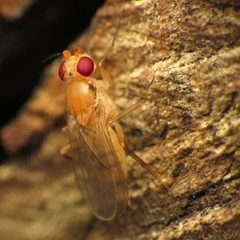
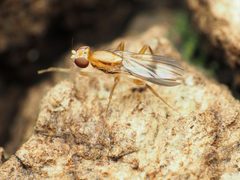
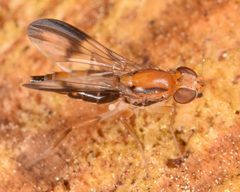
4A of small acalyptrate flies (approximately 3.5 mm) commonly known as druid flies. The family comprises 636 in 14 across three , with highest diversity in tropical regions. are typically found on tree trunks, while larvae inhabit decaying wood. Several genera exhibit lekking and territorial defense by males.
Pronunciation
How to pronounce Clusiidae: /kluːˈsiːɪdaɪ/
These audio files are automatically generated. While they are not always 100% accurate, they are a good starting point.
Identification
Distinguished from other acalyptrate flies by the triangular projection of the second antennal segment over the third segment. The combination of interrupted near subcosta, fully developed subcosta, large vibrissae, and vertical plate reaching the margin provides additional diagnostic characters. The partially infuscated wings and cylindrical body form are supportive features.
Images
Appearance
Small (approximately 3.5 mm), slender flies with cylindrical bodies. Coloration ranges from yellow to black. is rounded with large vibrissae. The second antennal segment has a distinctive triangular projection over the third segment when viewed externally. Wings are usually partially infuscated. is interrupted near the subcosta, which is developed throughout its length. Vertical plate of the head reaches the margin of the .
Habitat
occur on tree trunks. Larvae develop in the bark and decaying wood of trees, specifically between layers of whitewood (sapwood and heartwood) that is wet and decay-softened. Found in forested environments with standing or fallen dead wood.
Distribution
distribution across all biogeographic regions, with greatest in tropical areas. Recorded from North America, Central America, South America, Europe, Asia, Africa, and Australasia. Specific regional records include: Nearctic (USA, Canada), Neotropical (Mexico, Brazil, Rica, Ecuador, Peru, Bolivia), Palearctic (England, Finland, France, Norway, Russia, Scotland, Portugal), Oriental, Afrotropical, and northern Australia.
Life Cycle
Larvae develop in decaying wood, particularly in wet, softened whitewood between growth layers. Larvae possess a distinctive feeding mechanism involving spot-sucking of biofilm coating wet, decaying wood. Larvae are notable for their ability to jump. can be identified to using morphological characters.
Behavior
Males of many in Clusiodinae engage in lekking . Males of Heteromeringia nitida use bicoloured forelegs to defend mating territories, representing the first recorded agonistic behavior in that . Males of Craspedochaeta pullipleura exhibit agonistic male-male interactions. Sobarocephala icmbio shows behavior at night on undersides of broad leaves.
Ecological Role
Larvae are xylophilic decomposers that inhabit decaying wood, contributing to wood decomposition processes. Form within rotting wood alongside other insects including Coleoptera and other Diptera.
Similar Taxa
- Other acalyptrate Diptera familiesDistinguished by the unique antennal structure with triangular projection of the second segment over the third, interrupted near subcosta, and large vibrissae.
Sources and further reading
- BugGuide
- Wikipedia
- GBIF taxonomy match
- Catalogue of Life
- Revision of the New World Hendelia (Diptera: Clusiidae: Clusiodinae)
- Revision of the New World Heteromeringia (Diptera: Clusiidae: Clusiodinae).
- Revision of the New World species of Craspedochaeta (Diptera: Clusiidae)
- Ecology of the larvae of xylophilic druid flies (Diptera, Clusiidae)
- World Catalogue of the Druid Flies (Diptera: Schizophora: Clusiidae)
- Revision of the Old World Sobarocephala (Diptera: Clusiidae)
- Development sites and early stages of eleven species of Clusiidae (Diptera) occurring in Europe
- Insect (Hexapoda) Diversity in the Oceanic Archipelago of Fernando de Noronha, Brazil: Clusiidae (Diptera)
- New records of Micropezidae, Clusiidae and Periscelididae (Diptera: Acalyptrata) from Portugal
- Phylogenetic analysis of the druid flies (Diptera: Schizophora: Clusiidae) based on morphological and molecular data
- Four new species of the genus Hendelia Czerny, 1903 (Diptera, Clusiidae) from China.