
Baetiscidae
Edmunds & Traver, 1954
armored mayflies
Genus Guides
1- Baetisca(armored mayflies)
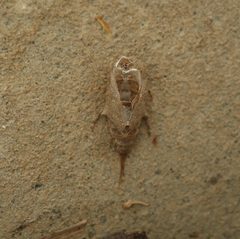
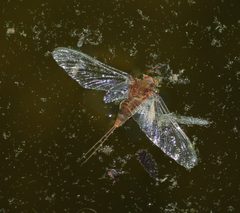
is a of mayflies distinguished by their heavily armored nymphs bearing a robust, spiked thoracic notal shield that extends over part of the . The family contains a single extant , Baetisca, with approximately 12 to North America. Three extinct genera (Protobaetisca, Balticobaetisca, Koonwarrabaetisca) are known from Cretaceous and Eocene deposits, indicating a Pangean origin for the family by at least the Early Jurassic. Together with , Baetiscidae forms the clade Carapacea, characterized by specialized larval armor.
Pronunciation
How to pronounce Baetiscidae: //ˌbaɪtɪˈskaɪdiː//
These audio files are automatically generated. While they are not always 100% accurate, they are a good starting point.
Identification
Nymphs are immediately recognizable by the distinctive thoracic notal shield: a hardened, spined structure covering the and extending posteriorly to cover abdominal segments 1–6. This armor separates from all other . lack this armor and are more typical in form, requiring examination of wing venation and genitalia for identification. Fossil are distinguished by shortened thoracic sterna (Protobaetiscinae) versus the condition in extant Baetisca.
Images
Habitat
Extant inhabit flowing water pools and stream edges with stony substrate, often where filamentous accumulate. Nymphs occupy microhabitats with accumulated detritus, particularly during final instars. Fossil evidence suggests similar ecological specialization in extinct lineages.
Distribution
Extant: North America, ranging from eastern United States through Great Plains to Northwest Territories of Canada; recently extended to Saskatchewan and Alberta. Fossil: Early Cretaceous Brazil (Crato Formation), Eocene Europe/Russia (Baltic amber), Early Cretaceous Australia (Koonwarra Fossil Bed). Historical distribution consistent with Pangean origin.
Seasonality
Nymphs hatch from in late summer (August–September), overwinter under ice, and emerge as the following early summer (June–July). This pattern has been documented in northern .
Diet
Nymphs are , consuming fine particulate organic matter.
Life Cycle
→ nymph (with multiple instars, ) → subimago → . Nymphal development spans approximately 10 months, including a winter under ice. occurs in early summer.
Behavior
Nymphs are benthic dwellers with limited capabilities, restricted to suitable microhabitats within streams. The shows limited dispersal, contributing to regional patterns.
Ecological Role
Nymphs function as / in stream , processing fine organic matter. They serve as prey for fish and other aquatic .
Human Relevance
Used as bioindicators of stream water quality due to specific requirements. Subject of ecological and taxonomic research; no known economic importance.
Similar Taxa
- ProsopistomatidaeShares clade Carapacea and unusual larval specialization, but nymphs have -like form rather than spined thoracic shield
- Other Ephemeroptera familiesAll lack the distinctive notal shield that defines nymphs
More Details
Phylogenetic classification
In 2024, Godunko and Sroka established two : Baetiscinae (extant Baetisca + Balticobaetisca) and Protobaetiscinae (Protobaetisca + Koonwarrabaetisca), the latter defined by markedly shortened thoracic sterna. Protobaetiscinae is sister to Baetiscinae.
Historical biogeography
The discovery of Koonwarrabaetisca in Australia confirms had nearly worldwide distribution during the Mesozoic. Given limited abilities, this pattern indicates origin on Pangea prior to continental breakup, pushing origin to at least Early Jurassic.
Sources and further reading
- BugGuide
- Wikipedia
- GBIF taxonomy match
- iNaturalist taxon
- NCBI Taxonomy
- Catalogue of Life
- The Life History and Ecology of Baetisca rogersi Berner (Ephemeroptera: Baetiscidae)
- A new mayfly subfamily sheds light on the early evolution and Pangean origin of Baetiscidae (Insecta: Ephemeroptera)
- Ecological Life History of Baetisca Berneri Tarter and Kirchner From a West Virginia Stream (Ephemeroptera: Baetiscidae)
- Baetisca (Ephemeroptera: Baetiscidae) from the western interior of Canada with notes on the life cycle
- Ecological Life History of Baetisca Carolina Traver in Panther Creek, Nicholas County, West Virginia (Ephemeroptera: Baetiscidae)
- Identification and Distribution of <i>Baetisca</i> Nymphs (Ephemeroptera: Baetiscidae) in Wisconsin
- Life History and Ecology ofBaetisca Bajkovi Neave, inBeech Fork of Twelvepole Creek,Wayne County. West Virginia(Ephemeroptera: Baetiscidae)