
Scutigerella
Ryder, 1882
garden symphylans, garden centipedes (misapplied)
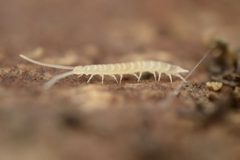
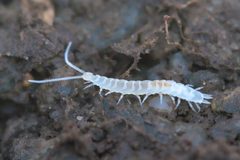
Scutigerella is a of symphylans (class Symphyla) established by John A. Ryder in 1882, with S. immaculata as the type . It is the second-largest genus in the Scutigerellidae, comprising at least 35 extant species plus two fossil species preserved in amber. Species range from 3.5 to 9 mm in length and are characterized by a -shaped with on the surface, 20–50 segmented , 15 tergites with notched margins, and 12 pairs of legs. The genus has a subcosmopolitan distribution centered in northern temperate zones, with introduced in Australasia and Oceania.
Pronunciation
How to pronounce Scutigerella: /skuː.tɪ.dʒɛˈrɛl.lə/
These audio files are automatically generated. While they are not always 100% accurate, they are a good starting point.
Identification
Distinguished from other by the combination of: -shaped with lobes (vs. rounded or different head shapes in related genera); positioned on surface of head; 15 tergites with specifically notched margins and modified tergites 3, 6, 9, 12, 14; deep U-shaped cavity between ; and stylus present on legs 3–12. Antennal segment count (20–50) and leg segmentation pattern (4 segments on first leg pair, 5 on others) provide additional diagnostic characters. Fossil identified by preservation in amber with characteristic tergite and head .
Images
Habitat
Soil-dwelling arthropods found primarily in soils with thick mats of litter and humus, and in the root zones of pasture soils. Greatest abundance and complexity in undisturbed where climate, vegetation, soils, and litter type combine to provide suitable humidity and temperature. Agricultural and garden soils also inhabited, with some becoming pests in cultivated systems.
Distribution
Subcosmopolitan distribution centered in northern temperate zones. Native range extends across Palearctic, Nearctic, Neotropical, Afrotropical, and Indomalayan realms. Introduced to Australasian and Oceanian realms. Documented from Italy, Austria, Spain, China, and United States among other locations.
Ecological Role
Soil-dwelling component of soil fauna; densities have been observed reaching 788 individuals/m² in favorable undisturbed . Abundance positively correlated with physicochemical properties of litter soil and vegetation. Serves as prey for mites (e.g., Pergamasus quisquiliarum).
Human Relevance
Some , particularly (the ), are agricultural pests of economic significance. Subject to 15-year distribution surveys in the United States and studies on laboratory rearing and reproductive management. "garden centipede" frequently misapplied, though symphylans are not centipedes.
Similar Taxa
- SymphylellaCo-occurs in similar soil and shares general body plan; distinguished by differences in shape, tergite structure, and antennal segmentation
- Scolopendra (centipedes) "garden centipede" leads to confusion; Scutigerella has 12 leg pairs and 15 tergites vs. variable but generally higher leg pair counts in centipedes, plus fundamental differences in structure and trunk segmentation
Misconceptions
Frequently misidentified or misnamed as "garden centipedes" due to superficial resemblance and usage; symphylans are a distinct class (Symphyla) separate from centipedes (Chilopoda), with different body plans, leg numbers, and ecological roles.
More Details
Fossil record
Two fossil described from amber: Scutigerella dominicana (1995) from Dominican amber (25–40 million years ago), the first fossil described based on specimens; and Scutigerella baltica (2004) from Baltic amber (40–50 million years ago), the first fossil symphylan described from an specimen. Fossil symphylans are exceptionally rare.
Taxonomic history
First Chinese described in 2023 with accompanying mitogenomic and genetic divergence analysis, expanding documented range of the .
Sources and further reading
- BugGuide
- Wikipedia
- GBIF taxonomy match
- iNaturalist taxon
- NCBI Taxonomy
- Catalogue of Life
- Factors That Affect Reproduction of the Garden Symphylan, Scutigerella immaculata1
- The biology of the garden centipede,Scutigerella immaculata
- Distribution of the Garden Symphylan, Scutigerella immaculata, in the United States—a 15-Year Survey1
- Biology of the Predaceous Mite, Pergamasus quisquiliarum1 on the Garden Symphylan, Scutigerella immaculata2 in the Laboratory3
- Bionomics of Symphyla (Myriapoda). with special reference to garden Symphylid Scutigerella immaculata Newport
- Description of the first species of Scutigerella (Symphyla, Scutigerellidae) from China, with mitogenomic and genetic divergence analysis.