
Macrosternodesmidae
Brölemann, 1916
Genus Guides
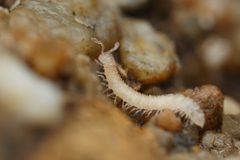
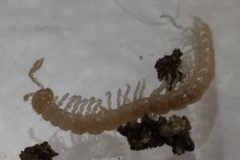
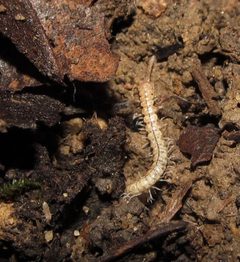
1Macrosternodesmidae is a of flat-backed millipedes in the order Polydesmida, primarily distributed in western North America with some European representatives. The family contains approximately 9 and 16 described , though taxonomic status remains disputed—some authorities treat it as a junior synonym of Trichopolydesmidae, while others recognize it as valid with two : Macrosternodesminae and Nearctodesminae. Many species are troglobionts restricted to cave systems.
Pronunciation
How to pronounce Macrosternodesmidae: //ˌmækroʊˌstɜːrnoʊˈdɛzmɪdiː//
These audio files are automatically generated. While they are not always 100% accurate, they are a good starting point.
Identification
Macrosternodesminae: small body size (2.5–12 mm), often lacking pigment, short with bulbous segments, tergites with setae arranged on rows of . Nearctodesminae: larger body size (10–35 mm), often brown, orange, pink, or red, long antennae with cylindrical distal segments, tergites smooth and lacking setae. Both feature a small collum shaped like a transverse oval and well-developed paranota.
Images
Habitat
Predominantly hypogean (cave) environments, including high-altitude limestone caves; some occur in epigean settings. Western North American species are associated with cave systems in Arizona, California, Colorado, and Nevada, USA, plus Baja California Norte, Mexico.
Distribution
Western North America: Arizona, California, Colorado, Nevada (USA), Baja California Norte (Mexico). Also recorded from Denmark, Norway, and Sweden (GBIF). European include Macrosternodesmus and three other genera.
Behavior
Many are troglobionts (obligate cave-dwellers), likely exhibiting troglomorphic adaptations such as reduced pigmentation and elongated appendages. Macrosternodesminae species are frequently observed in cave systems.
Ecological Role
Component of cave faunal ; contributes to in cave . In Tonto National Forest Cave #34, Arizona, the macrosternodesmid Nevadesmus superstitiona co-occurs with 31 other animal including four other troglobionts.
Similar Taxa
- TrichopolydesmidaeTaxonomic synonymy disputed; some authorities treat Macrosternodesmidae as junior synonym, while others maintain both as separate with different generic compositions.
- NearctodesmidaeTreated as junior synonym by some authorities; in 2017, Shear and Reddell placed Nearctodesmidae into new Nearctodesminae within Macrosternodesmidae.
More Details
Taxonomic Controversy
status disputed since 2013. Golovatch (2013) proposed Macrosternodesmidae as junior synonym of Trichopolydesmidae; Shear and Reddell (2017) rejected this, retaining Macrosternodesmidae as valid. Generic composition also contested—some authorities place Macrosternodesmus, Packardesmus, and Coloradesmus in Trichopolydesmidae instead.
Subfamily Classification
Shear and Reddell (2017) established two : Macrosternodesminae (Brölemann, 1916) with 11 including Chaetaspis, Coloradesmus, Macrosternodesmus, Nevadesmus, Ophiodesmus, Packardesmus, Pratherodesmus, Sequoiadesmus, Speodesmus, Speorthus, and Tidesmus; and Nearctodesminae (Chamberlin & Hoffman, 1950) with 5 genera including Bistolodesmus, Ergodesmus, Kepolydesmus, Leonardesmus, and Nearctodesmus.
Sources and further reading
- BugGuide
- Wikipedia
- GBIF taxonomy match
- iNaturalist taxon
- NCBI Taxonomy
- Catalogue of Life
- The milliped genus Tidesmus Chamberlin, 1943 (Polydesmida: Macrosternodesmidae)
- Cave millipedes of the United States. XVII. A new troglobiotic Nevadesmus Shear, 2009 from an Arizona cave (Diplopoda, Polydesmida, Macrosternodesmidae) with observations on associated fauna and ecology
- Figures 26- 27 from: Shear WA, Steinmann DB (2019) Cave millipedes of the United States. XV. Coloradesmus gen. nov. (Diplopoda, Polydesmida, Macrosternodesmidae), and four new species from caves in Colorado, USA. Subterranean Biology 32: 15-32. https://doi.org/10.3897/subtbiol.32.38161
- Figures 1-6 from: Shear WA, Steinmann DB (2019) Cave millipedes of the United States. XV. Coloradesmus gen. nov. (Diplopoda, Polydesmida, Macrosternodesmidae), and four new species from caves in Colorado, USA. Subterranean Biology 32: 15-32. https://doi.org/10.3897/subtbiol.32.38161
- Figures 7-10 from: Shear WA, Steinmann DB (2019) Cave millipedes of the United States. XV. Coloradesmus gen. nov. (Diplopoda, Polydesmida, Macrosternodesmidae), and four new species from caves in Colorado, USA. Subterranean Biology 32: 15-32. https://doi.org/10.3897/subtbiol.32.38161
- Figures 15-20 from: Shear WA, Steinmann DB (2019) Cave millipedes of the United States. XV. Coloradesmus gen. nov. (Diplopoda, Polydesmida, Macrosternodesmidae), and four new species from caves in Colorado, USA. Subterranean Biology 32: 15-32. https://doi.org/10.3897/subtbiol.32.38161
- Figures 28- 29 from: Shear WA, Steinmann DB (2019) Cave millipedes of the United States. XV. Coloradesmus gen. nov. (Diplopoda, Polydesmida, Macrosternodesmidae), and four new species from caves in Colorado, USA. Subterranean Biology 32: 15-32. https://doi.org/10.3897/subtbiol.32.38161
- Figures 11-14 from: Shear WA, Steinmann DB (2019) Cave millipedes of the United States. XV. Coloradesmus gen. nov. (Diplopoda, Polydesmida, Macrosternodesmidae), and four new species from caves in Colorado, USA. Subterranean Biology 32: 15-32. https://doi.org/10.3897/subtbiol.32.38161
- Figures 21-25 from: Shear WA, Steinmann DB (2019) Cave millipedes of the United States. XV. Coloradesmus gen. nov. (Diplopoda, Polydesmida, Macrosternodesmidae), and four new species from caves in Colorado, USA. Subterranean Biology 32: 15-32. https://doi.org/10.3897/subtbiol.32.38161
- Map 1 from: Shear WA, Steinmann DB (2019) Cave millipedes of the United States. XV. Coloradesmus gen. nov. (Diplopoda, Polydesmida, Macrosternodesmidae), and four new species from caves in Colorado, USA. Subterranean Biology 32: 15-32. https://doi.org/10.3897/subtbiol.32.38161