
Trichopetalidae
Verhoeff, 1914
Genus Guides
3Trichopetalidae is a of small millipedes in the order Chordeumatida. possess 28 or 30 body segments, counting the collum as the first and the as the last. The family comprises seven and approximately 43 , with members exhibiting diverse ecological strategies ranging from surface-dwelling to obligate cave-dwelling (troglobitic) lifestyles.
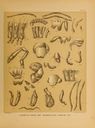
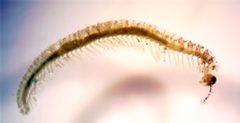
Pronunciation
How to pronounce Trichopetalidae: /tɹɪkoʊpɛtælaɪdiː/
These audio files are automatically generated. While they are not always 100% accurate, they are a good starting point.
Identification
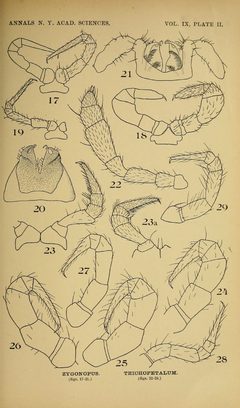
Distinguished from other Chordeumatida by the combination of 28–30 segments and specific . Within the family, are distinguished by generic composition: Mexiterpetinae contains only Mexiterpes, while Trichopetalinae contains the remaining (Trichopetalum, Zygonopus, Scoterpes, Causeyella, Nannopetalum, Trigenotyla). Genus-level identification relies on ecological habit (surface vs. cave-dwelling) and detailed gonopod structure.
Images
Appearance
have 28 or 30 segments (including collum and ). Members of the Trichopetalum produce a sticky secretion from the bases of segmental setae, possibly serving a defensive function. have been described for at least one (Trichopetalum dux), representing the first authenticated chordeumatidan spermatophores.
Habitat
Ecologically heterogeneous. Trichopetalum are surface-dwelling or troglophilic (cave-edge dwelling). Zygonopus and Scoterpes consist entirely of troglobitic (obligate cave-dwelling) species. Causeyella species are troglobitic in southern Ozark caves. Mexiterpes occurs in Mexico. Cave-dwelling species occupy deep cave systems, often in specific microhabitats such as moist rocky areas near waterfalls.
Distribution
North America, with records from Alabama, Georgia, Illinois, Indiana, Kentucky, Tennessee, Virginia, West Virginia, the Ozark Plateau region, and Mexico. Specific cave systems in the Appalachian Mountains and Ozark Plateau harbor multiple troglobitic .
Behavior
Causeyella have been studied under laboratory conditions, though specific are not detailed in available sources. Trichopetalum species produce a sticky secretion from segmental setae bases, possibly defensive. cave-dwelling individuals may construct larger webs when positioned deeper in caves to compensate for reduced prey availability—this behavior is inferred from observations of a (Meta ovalis spider) preying on Causeyella millipedes.
Ecological Role
Troglobitic serve as prey for cave-dwelling , including the cave orbweaver spider Meta ovalis (Tetragnathidae), which has been documented preying on Causeyella millipedes. They contribute to nutrient cycling in cave through detritivory.
Human Relevance
Subject of cave and biospeleology research due to high and restricted distributions. Some likely represent "superspecies" complexes with genetically isolated , making them important for studies of subterranean evolution and conservation. Fauna of caverns is poorly known, and many species may be to single cave systems.
Similar Taxa
- Other Chordeumatida familiesTrichopetalidae is distinguished by 28–30 segments and specific ; other in the order may differ in segment number or reproductive structures.
- Surface-dwelling vs. cave-dwelling Trichopetalidae generaWithin the , ecological habit differs markedly: Trichopetalum is surface/troglophilic while Zygonopus and Scoterpes are obligate troglobites with convergent adaptations to cave life.
More Details
Subfamily classification
The is divided into two : Mexiterpetinae (containing only Mexiterpes) and Trichopetalinae (containing Trichopetalum, Zygonopus, Scoterpes, Causeyella, Nannopetalum, and Trigenotyla, with tribe Scoterpetini established for some groupings).
Taxonomic history
Zygonopus was resurrected from synonymy with Trichopetalum; Scoterpes was also clarified as distinct. These revisions recognized four troglobitic in Zygonopus and multiple new species in Scoterpes.
Conservation significance
Troglobitic in this often have extremely restricted ranges, with some possibly to single caves. At least Scoterpes copei and S. ventus likely represent 'superspecies' consisting of numerous genetically isolated awaiting molecular study.
Sources and further reading
- BugGuide
- Wikipedia
- GBIF taxonomy match
- iNaturalist taxon
- NCBI Taxonomy
- Catalogue of Life
- Bug Eric: Spider Sunday: Cave Orbweaver
- The milliped family Trichopetalidae, Part 2: The genera Trichopetalum, Zygonopus and Scoterpes (Diplopoda: Chordeumatida, Cleidogonoidea)
- Laboratory observations on the behavior of two troglobitic millipede species in the genus Causeyella (Chordeumatida: Trichopetalidae) from the southern Ozarks