
Cryptops hortensis
(Donovan, 1810)
Common Cryptops
Cryptops hortensis is a small in the Cryptopidae, commonly known as the Common Cryptops. It is native to Europe and has been introduced to Tasmania, Australia, and southwestern Siberia, Russia. The is frequently found in human-modified including gardens and greenhouses.
Pronunciation
How to pronounce Cryptops hortensis: //ˈkrɪptɒps hɔːˈtɛnsɪs//
These audio files are automatically generated. While they are not always 100% accurate, they are a good starting point.
Identification
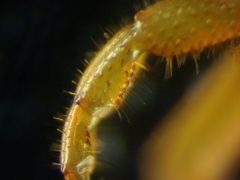
Distinguished from other Cryptops by the combination of small size (20–30 mm), 21 leg pairs, and pale brown coloration. Accurate identification to species level typically requires examination of terminal leg modifications and other subtle morphological features not visible in field observation. Similar European Cryptops species require microscopic examination for definitive separation.
Images
Appearance
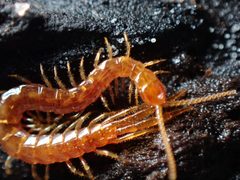
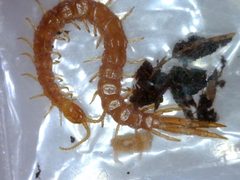
Elongated, slender body measuring 20–30 mm in length and approximately 1 mm in width. Pale brown in coloration. Possesses 21 pairs of legs, typical for the Cryptops. Body form is dorsoventrally flattened.
Habitat
Found in gardens, woodland areas, and under stones and logs. Records from southwestern Siberia and the Cis-Urals region are confined to heated greenhouses, suggesting the requires warmer conditions than the surrounding climate provides. Appears to favor moist, sheltered microhabitats with access to decaying organic matter.
Distribution
Native to most of Europe, absent from the Baltic states, Andorra, Belarus, Liechtenstein, Luxembourg, Moldova, Russia, Vatican City, and various European islands. Introduced to Tasmania, Australia. Disjunct in southwestern Siberia (Kemerovo region) and the Cis-Urals, Russia, associated with greenhouse environments.
Behavior
typical of soil-dwelling . Seeks shelter under stones and logs during daylight hours. Has been observed in greenhouse environments in Russia, suggesting adaptability to artificial conditions.
Ecological Role
Predatory component of soil and leaf litter . Contributes to regulation of small in ground-level .
Human Relevance
Introduced in greenhouses in Russia indicate potential for human-mediated . Presence in gardens suggests of moderate anthropogenic disturbance. Not known to pose any direct threat to human health or agriculture.
Similar Taxa
- Cryptops parisiOverlapping European distribution and similar size; requires examination of tibial and tarsal spination patterns for separation
- Other Cryptops species-level similarity in body plan and leg count; identification relies on subtle characters of the ultimate legs and sternal structures
More Details
Introduced range expansion
The has been documented in heated greenhouses in southwestern Siberia and the Cis-Urals, representing significant eastward range extensions beyond its native European distribution. These are maintained by artificial heating and would not survive outdoor conditions in these regions.
Taxonomic note
The basionym Scolopendra hortensis Donovan, 1810 reflects early classification of within a broadly defined Scolopendra; the was later transferred to Cryptops as the was refined.
Sources and further reading
- BugGuide
- Wikipedia
- GBIF taxonomy match
- iNaturalist taxon
- NCBI Taxonomy
- Catalogue of Life
- King of the Cave: New centipede on top of the food chain in the sulphurous-soaked Movile | Blog
- Glorious Earthworms - Buglife Blog - Buglife
- FIRST RECORD OF CRYPTOPS (CRYPTOPS) HORTENSIS (DONOVAN, 1810) IN SOUTHWESTERN SIBERIA, RUSSIA (CHILOPODA: SCOLOPENDROMORPHA: CRYPTOPIDAE)
- FIRST RECORD OF <i>CRYPTOPS HORTENSIS</i> (DONOVAN 1810) (SCOLOPENDROMORPHA, CRYPTOPIDAE) IN THE CIS-URALS