
Cryptops
Leach, 1814
cave centipedes
Species Guides
2- Cryptops hortensis(Common Cryptops)
- Cryptops leucopodus
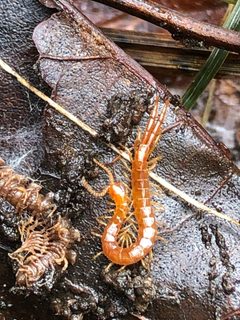
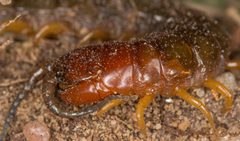
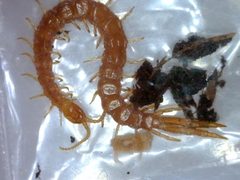
Cryptops is a of in the Cryptopidae, commonly referred to as cave centipedes. The genus has a worldwide distribution with numerous documented across Europe, Asia, and other regions. Some species exhibit troglobitic adaptations, including Cryptops speleorex from Romania's Movile Cave, which has evolved in isolation for millions of years in a chemosynthetic . studies have revealed greater than previously recognized, with cryptic species and large genetic distances between morphologically similar .
Pronunciation
How to pronounce Cryptops: /ˈkɹɪptɒps/
These audio files are automatically generated. While they are not always 100% accurate, they are a good starting point.
Identification
Accurate identification within Cryptops requires molecular analysis due to morphological similarity between species. using COI sequences has revealed cryptic diversity, with interspecific genetic distances ranging from 13.7% to 22.2% and clear barcoding gaps between species. The is distinguished from other genera by -level characters of Cryptopidae.
Images
Habitat
vary by : many occupy soil and leaf litter in temperate regions, while some species are troglobitic, restricted to cave systems. Cryptops hortensis has been recorded from greenhouses in southwestern Siberia and the Cis-Urals, suggesting tendencies in some . The troglobitic species Cryptops speleorex inhabits the sulphurous, oxygen-poor Movile Cave in Romania, an dependent on chemosynthetic bacteria.
Distribution
Worldwide distribution with well-documented records from Central Europe (Germany, Austria, Poland, Croatia, Slovenia), southwestern Siberia and the Cis-Urals in Russia, and the Movile Cave system in Romania. Specific documented records include: Cryptops parisi across southern Poland in mountainous regions; C. hortensis in Western Europe, North Africa, the Middle East, and recently in southwestern Siberia and the Cis-Urals; C. croaticus in Austria; C. umbricus in Germany.
Ecological Role
Cryptops speleorex functions as an apex in the Movile Cave , representing the largest known inhabitant of this unique chemosynthetic . As a venomous predator, it occupies the top in this subterranean .
Human Relevance
Some show tendencies, with Cryptops hortensis recorded from greenhouses in Russia outside its native range. The has been subject to extensive taxonomic study using methods to resolve cryptic .
More Details
Etymology
The name derives from Ancient Greek κρυπτός (kruptós, 'hidden') and ὄψ (óps, ''), referring to the concealed or cryptic nature of these .
Cryptic diversity
Molecular studies of Central European Cryptops revealed 8-10 where only three were expected based on . The C. parisi complex in Germany comprises three geographically separate clades with high genetic divergence (8.4-11.3% between clades), potentially representing distinct species.
Troglobitic specialization
Cryptops speleorex from Movile Cave exhibits morphological and genetic divergence from surface-dwelling relatives, reflecting millions of years of evolution in isolation. This is adapted to extreme conditions including low oxygen and high sulphur concentrations.
Sources and further reading
- BugGuide
- Wikipedia
- iNaturalist taxon
- NCBI Taxonomy
- Catalogue of Life
- King of the Cave: New centipede on top of the food chain in the sulphurous-soaked Movile | Blog
- FIRST RECORD OF CRYPTOPS (CRYPTOPS) HORTENSIS (DONOVAN, 1810) IN SOUTHWESTERN SIBERIA, RUSSIA (CHILOPODA: SCOLOPENDROMORPHA: CRYPTOPIDAE)
- Distribution of Cryptops parisi Brolemann, 1920 (Chilopoda, Scolopendromorpha) in Poland
- Figure 1 from: Wesener T, Voigtländer K, Decker P, Oeyen JP, Spelda J (2016) Barcoding of Central European Cryptops centipedes reveals large interspecific distances with ghost lineages and new species records from Germany and Austria (Chilopoda, Scolopendromorpha). ZooKeys 564: 21-46. https://doi.org/10.3897/zookeys.564.7535
- Figure 4 from: Wesener T, Voigtländer K, Decker P, Oeyen JP, Spelda J (2016) Barcoding of Central European Cryptops centipedes reveals large interspecific distances with ghost lineages and new species records from Germany and Austria (Chilopoda, Scolopendromorpha). ZooKeys 564: 21-46. https://doi.org/10.3897/zookeys.564.7535
- Figure 3 from: Wesener T, Voigtländer K, Decker P, Oeyen JP, Spelda J (2016) Barcoding of Central European Cryptops centipedes reveals large interspecific distances with ghost lineages and new species records from Germany and Austria (Chilopoda, Scolopendromorpha). ZooKeys 564: 21-46. https://doi.org/10.3897/zookeys.564.7535
- Figure 5 from: Wesener T, Voigtländer K, Decker P, Oeyen JP, Spelda J (2016) Barcoding of Central European Cryptops centipedes reveals large interspecific distances with ghost lineages and new species records from Germany and Austria (Chilopoda, Scolopendromorpha). ZooKeys 564: 21-46. https://doi.org/10.3897/zookeys.564.7535
- FIRST RECORD OF <i>CRYPTOPS HORTENSIS</i> (DONOVAN 1810) (SCOLOPENDROMORPHA, CRYPTOPIDAE) IN THE CIS-URALS