
Triaenodes
McLachlan, 1865
Species Guides
8- Triaenodes aba(Aba's Long-horned Caddisfly)
- Triaenodes baris
- Triaenodes dipsia
- Triaenodes flavescens
- Triaenodes injusta
- Triaenodes marginata
- Triaenodes reuteri
- Triaenodes tardus(long-horned caddisfly)
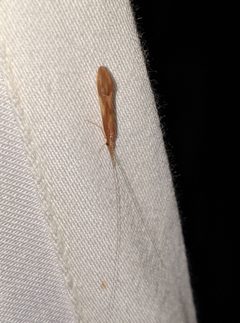
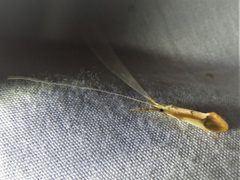
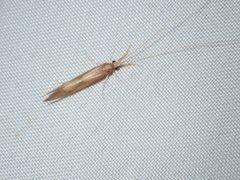
Triaenodes is a of long-horned caddisflies ( Leptoceridae) containing at least 170 described . The genus has a distribution, with species documented across the Neotropics, North America, Europe, and Asia. Larvae construct portable cases and are primarily aquatic, with some species exhibiting specialized swimming to navigate between aquatic macrophytes. The genus serves as the type genus for the tribe Triaenodini.
Pronunciation
How to pronounce Triaenodes: //traɪˈɛnəˌdiːz//
These audio files are automatically generated. While they are not always 100% accurate, they are a good starting point.
Identification
males are distinguished using genitalic characters; a key to males of Neotropical Triaenodes has been published. The Ylodes has been returned to synonymy with Triaenodes as a subgenus. -level identification requires examination of male genitalia or .
Images
Habitat
Aquatic environments, particularly clean fresh water. Larvae are associated with aquatic macrophytes; swimming decreases when vegetation is present, indicating primary use. Some inhabit benthic microhabitats with fine sediments.
Distribution
. Neotropical documented in Mexico, Guatemala, Rica, Nicaragua, Panama, Colombia, Ecuador, and Peru. Additional records from North America (including Vermont, USA), Europe (Denmark, Norway, Sweden, Poland), and Asia (Kyrgyzstan, Japan).
Life Cycle
Larval and pupal stages have been described for at least one Rican , representing first documentation of these stages for Neotropical Triaenodes. Complete details remain undocumented for most species.
Behavior
Larval swimming has been documented in Triaenodes tardus, achieving speeds of 1.47 cm/s while carrying cases. Swimming employs a stereotypic motion sequence and functions primarily to locate and move between aquatic macrophytes rather than to escape fine sediments. Swimming frequency decreases when vegetation is available.
Ecological Role
Benthic macroinvertebrate that moves between aquatic macrophytes via swimming. Larvae contribute to aquatic as primary consumers and serve as prey for aquatic . Some are considered rare and of conservation concern in parts of their range (e.g., T. unanimis in Poland).
Human Relevance
Triaenodes bicolor (the Bicolour Sedge) has been sequenced. Some are indicators of quality and are included in regional Red Lists of threatened species. The is used in biogeographic and phylogenetic studies of Trichoptera.
Similar Taxa
- Other Leptoceridae generaTriaenodes is distinguished by male genitalic and larval case construction; Ylodes has been synonymized as a subgenus.
- Other caddisfly familiesLong-horned caddisflies (Leptoceridae) are distinguished from other Trichoptera by typically exceeding body length in .
More Details
Taxonomic history
The type is Leptocerus bicolor J. Curtis (now Triaenodes bicolor). The subgenus Ylodes Milne has been returned to synonymy with Triaenodes.
Research significance
Triaenodes serves as a model for studying larval swimming mechanics in caddisflies and for understanding Trichoptera across multiple continents.
Sources and further reading
- BugGuide
- Wikipedia
- GBIF taxonomy match
- iNaturalist taxon
- NCBI Taxonomy
- Catalogue of Life
- The caddisfly genus Triaenodes in the Neotropics (Trichoptera: Leptoceridae)
- Mechanics and Ecological Role of Swimming Behavior in the Caddisfly Larvae Triaenodes tardus
- The occurrence of Triaenodes unanimis McLachlan, 1877 (Insecta: Trichoptera) and other rare species of caddisflies in the Powidz Landscape Park (Poland)
- A List of the Caddisflies (Insecta: Trichoptera) from Kyrgyzstan, with a New Record (Triaenodes reuteri McLachlan 1880)
- DNA barcoding and a new taxonomic status of the Triaenodes ochreellus lefkas Malicky, 1974 (Insecta, Trichoptera) with new distribution data
- The genome sequence of the Bicolour Sedge, Triaenodes bicolor (Curtis, 1834) (Trichoptera: Leptoceridae).